


Zhejiang Robot Industry Association
Zhejiang University Robotics Institute
Golden Conference & Exhibition Group
Hangzhou Wisdom Source Exhibition Co., Ltd.
Hangzhou Sequoia Exhibition Co., Ltd.
Ningbo Magnetic Materials Association
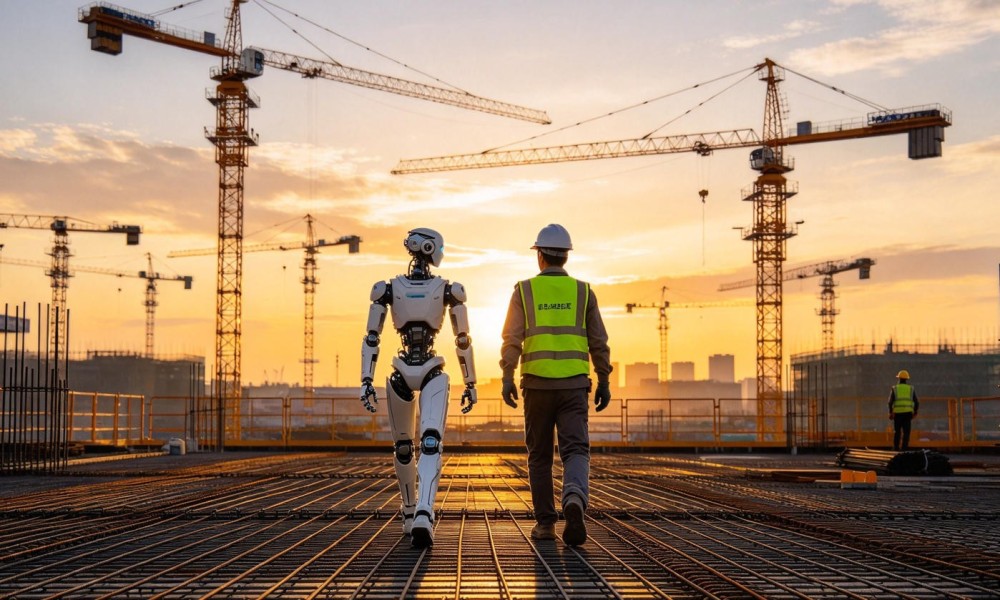
The buildings of the next decade may be raised, in part, by machines shaped like the people who raised the last ones. Humanoid robots — two-legged, two-armed machines designed to work in environments built for human bodies — are stepping out of demonstration videos and into one of the world's largest and least automated industries: construction.
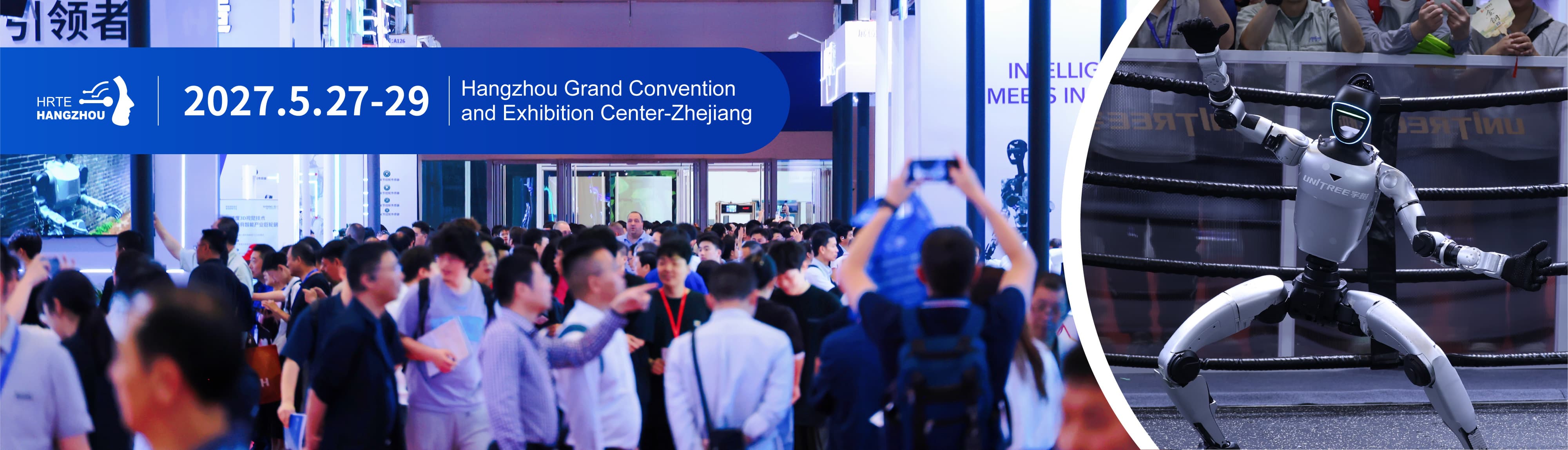
At first glance, it is an unlikely pairing. Construction is famously messy — mud, rebar, weather, noise — while robots have thrived mostly in the controlled order of factories and warehouses. But the industry's chronic labor shortage, its aging workforce, and its accelerating digitization are converging to make construction one of the most compelling near-term arenas for humanoid machines. It is a shift the industry will soon be able to inspect up close at The 3rd Hangzhou International Humanoid Robot and Robot Technology Exhibition 2027 (HRTE 2027), taking place May 27–29, 2027, at the Hangzhou Grand Convention and Exhibition Center in Zhejiang Province.
Construction builds the physical world, yet it has been slow to automate itself. Industry associations in the United States, Europe, and East Asia have warned for years that their members cannot fill skilled trade positions, and the problem is structural rather than cyclical: workforces are aging, fewer young workers are entering the trades, and decades of underinvestment in productivity have left much of the industry doing things much the way they were done a generation ago. According to public reports, a large majority of contractors in the United States report persistent difficulty filling both craft and salaried positions; in Japan, the construction workforce has aged steadily as retirements outpace new entrants; and in China, authorities have listed multiple construction-related trades among occupations facing recurrent worker shortages.
The result is a widening gap between how much the world needs built — housing, data centers, grid infrastructure, transport networks — and how many people are available to build it. Widely cited analyses have noted that construction productivity growth has lagged manufacturing for decades. When labor is scarce, schedules slip and costs rise, and contractors have little choice but to look for new sources of capacity. Industry estimates suggest that this scarcity, not novelty, is the real driver behind construction's growing interest in robots: contractors are not looking to replace cheap labor, because there is very little cheap labor left to replace.
Talk to the teams now piloting humanoid robots in industrial settings, and a consistent picture emerges of where the machines earn their keep first.
Material handling and site logistics top most lists. Construction sites constantly move pallets of blocks, rolls of membrane, buckets, tools, and fittings from laydown areas to work fronts — repetitive, physically punishing trips that consume skilled workers' time. A humanoid that can walk a route, pick up a load, and deliver it to wherever a crew is working removes thousands of steps a day from human backs.
Repetitive installation work is a close second. Drywall and panel installation — lifting heavy sheets and holding them in place while they are fastened — is awkward, exhausting, and chronically hard to staff. Similar logic applies to rebar-related repetitive work: positioning bars, tying intersections, and preparing cages are tasks with clear geometry and high repetition. Companies and research teams have demonstrated humanoid platforms performing such structured tasks in factory and prefabrication settings, according to public reports, and construction-adjacent pilots are following.
Inspection and progress monitoring suit robots especially well, because the job asks them to do what they are already good at: walk a defined route, look at things, and report. A humanoid equipped with cameras can capture progress imagery each evening, feed it into project-management software, and flag discrepancies against plan — a task that today competes with billable work for a foreman's attention.
Finally, there are the assistive roles: fetching and bringing tools, holding lights and workpieces, cleaning, running materials up and down. Unglamorous, but in an industry where a skilled electrician may spend a surprising share of the day hunting for parts, a "robot apprentice" that keeps the work front supplied is genuinely valuable.
What remains hard is equally clear. Unstructured terrain — mud, slopes, rubble, temporary stairs and scaffolding — is far more challenging than a factory floor, though legged robots have improved dramatically in recent years. Weather, dust, and moisture test sealing and electronics. And the fine trade skills that define craft occupations — welding, waterproofing, precision finishing — remain well beyond current manipulation capabilities, as industry observers have noted. Humanoids will start where tasks are structured and repetitive, and expand outward as the software matures.
Humanoids are arriving in an industry that already uses robots — just very specialized ones. Bricklaying systems that lay masonry several times faster than a crew, according to claims by their developers; robotic total stations that guide layout with millimeter precision; drywall-finishing and plastering robots; rebar-tying machines; exoskeletons that offload heavy loads from workers' spines; and large-format 3D printers that extrude entire wall structures — all have moved from demonstration to commercial use in recent years.
These machines excel because each is built around one process. The catch is that a construction site contains thousands of processes, most of them one-off. Specialized automation shines where work repeats at volume — a high-rise of identical floors, a subdivision of identical houses. It pencils out far less well when every task is slightly different from the last.
That is precisely the case for the humanoid form factor. A general-purpose robot can, in principle, move across a site designed for human bodies, use human tools, and be redeployed from one trade to another as the project evolves — one platform, many jobs. In practice, the two approaches are complements rather than substitutes: specialized machines remain the workhorses for high-volume processes, while humanoids target the long tail of varied, mobile, and assistive tasks that no single-purpose machine covers.
Robots do not just need bodies; they need models of the world, and construction is finally building them. Building Information Modeling (BIM) gives every element of a project a precise digital definition — what goes where, in what order, made of what. Digital twins and reality-capture tools keep those models synchronized with the actual state of the site. Several governments now encourage or mandate BIM on public projects, and adoption continues to climb across major markets, according to public reports.
This matters for robots more than it may first appear. A humanoid that can read a BIM model knows where the wall goes, which panel comes next, and in what sequence. Site-management platforms already schedule crews, deliveries, and inspections; a robot becomes simply another resource in the plan, dispatched by the same software that dispatches everything else. In effect, construction's digitization hands robots a machine-readable job description.
The flow runs both ways. A humanoid patrolling the site each evening generates fresh imagery, scan data, and safety telemetry that feed directly back into digital twins and progress dashboards — data contractors increasingly pay for anyway. Robots are thus not only consumers of the digital construction stack; they are its most mobile sensors. The more digitized a contractor's operations, the lower the integration cost of adding robots, which is why analysts expect the earliest adopters to be data-mature, large-scale contractors rather than the smallest firms.
A live construction site may be the most demanding environment in which any commercial robot will ever operate: the layout changes weekly, cranes swing overhead, vehicles reverse without warning, and dozens of trades share the same floor. Safety is therefore the gating issue.
Humanoid robots will need to fit into established site-safety regimes — exclusion zones, spotters, emergency-stop protocols, geofenced routes — and someone will have to certify that they do. As industry publications have noted, there is no settled standard today for a legged robot sharing floor space with ironworkers. Early deployments can be expected to proceed conservatively: fenced zones, low-traffic shifts, and carefully documented safety cases.
Liability raises equally novel questions. If a humanoid drops a panel or clips a scaffold, responsibility must be traced across contractor, vendor, integrator, and operator — a chain insurers have yet to build actuarial categories for. Expect early pilot contracts to allocate risk explicitly and conservatively while the frameworks catch up. None of this is disqualifying; it is simply the cost of bringing a genuinely new class of machine into one of the most heavily regulated workplaces in the economy.
Contractors do not buy robots; they buy schedule certainty, safety records, and lower cost per unit installed. The business case for humanoids rests on all three. A robot can work long shifts without overtime, does not fatigue, reduces exposure to the lifting and repetitive-motion injuries that drive compensation costs, and — critically in a labor-scarce market — keeps work fronts supplied when crews run short.
The decisive variable is utilization. A humanoid that stands idle most of each shift is expensive dead weight on a jobsite, which is why early adoption is expected to favor business structures that keep machines busy across tasks and spread their cost across projects. That points toward rental and fleet-operator models: robots dispatched from project to project the way scaffolding, hoists, and access platforms are today. Equipment rental firms — already masters of utilization economics — are natural candidates to become the construction industry's robot fleet operators.
Unit economics, industry estimates suggest, improve on two fronts at once: hardware costs are falling as humanoid supply chains scale, and software capability rises with every deployment. For contractors, the smart framing of an early pilot is not line-item savings but option value — learning where robots fit in their workflows before their competitors do.
The humanoid build-out is global. Companies and research teams in North America, Europe, Japan, and above all China have demonstrated humanoid platforms working in factories, warehouses, and — increasingly — construction-related settings, according to public reports. Most deployments to date remain indoors, in structured environments; the open construction site is a harder frontier. But the trajectory is unmistakable, and the competitive geography matters.
China has a credible claim to be the first large market. It is the world's largest construction market by volume, with a policy-backed push toward prefabricated and modular building methods that create exactly the structured, repetitive environments robots handle best. It hosts one of the world's most complete robotics supply chains — actuators, dexterous hands, sensors, batteries — which drives hardware costs down faster than anywhere else. National and local governments have designated humanoid robots a strategic industry, according to public reports, backing pilot programs across manufacturing and services. And its construction workforce is aging too, adding urgency to the search for mechanical hands. Where scale, supply chain, and urgency converge, robots deploy — and deployment, not laboratory demos, is what makes them improve.
For the industry's stakeholders, the implications differ by seat. Contractors should run small, well-instrumented pilots now and tighten their data practices, because robots ride on digital foundations. Developers should watch how robot-capable construction feeds into project cost and timeline models. Equipment rental firms face a new product category arriving faster than most expect. And investors, rather than betting solely on the robot-makers themselves, may find the durable value in the integration, safety, and fleet-operations layer that turns machines into billable hours.
Where should a construction-sector professional see this wave firsthand — and put names to the machines? A practical answer is now on the calendar. HRTE 2027, taking place May 27–29, 2027, at the Hangzhou Grand Convention and Exhibition Center in Zhejiang Province, will bring together humanoid robot manufacturers, core component suppliers, integrators, and application enterprises under one roof. Contractors, developers, and rental firms will find exhibits spanning whole-body platforms, dexterous hands and actuators, sensors and batteries, as well as the software and services needed to put robots to work — an efficient way to evaluate suppliers, book pilot discussions, and scout partners ahead of the next build season. Whether the goal is to exhibit, to source, or simply to see how far these machines have come, HRTE 2027 belongs on the calendar of everyone who builds the built world.