
Zhejiang Robot Industry Association
Zhejiang University Robotics Institute
Golden Conference & Exhibition Group
Hangzhou Wisdom Source Exhibition Co., Ltd.
Hangzhou Sequoia Exhibition Co., Ltd.
Ningbo Magnetic Materials Association
Public industry information shows that global data centers are entering a new round of expansion cycles. The vision of “deploying robots to replace human workers in computer rooms” is moving from concept demonstrations to live pilot deployments. In 7×24-hour continuously operated computer rooms, operation and maintenance teams are long burdened by on-duty shifts, heavy manual handling, and occupational health & safety risks. Meanwhile, the 3rd Hangzhou International Humanoid Robot & Robotics Technology Exhibition 2027 (HRTE 2027, May 27–29, 2027, Hangzhou Grand Convention & Exhibition Center) serves as a key window to observe this trend. How humanoid robots move from exhibition halls into actual cold aisles of computer rooms has become a topic of shared interest for the industry and capital markets.
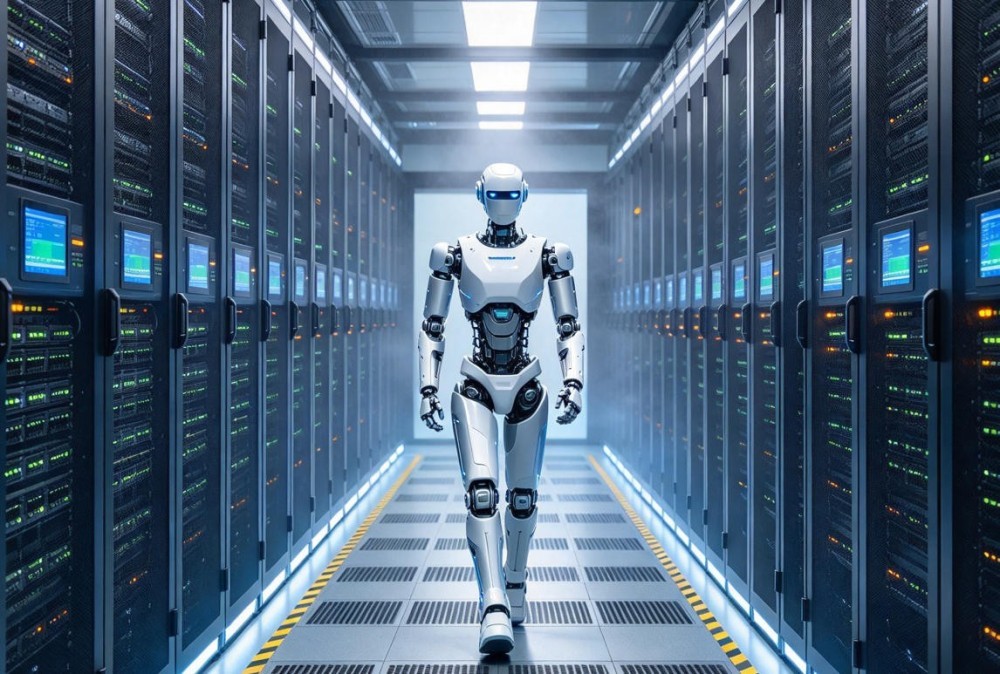
The lifeline of a data center is uninterrupted service. According to public reports, large-scale data centers generally adopt a 7×24 on-duty model. Operation and maintenance staff work rotating shifts and stay on-site long-term to respond to sudden alerts and routine inspections.
A more tangible challenge is heavy physical labor. Installing, removing and relocating a standard server, battery module or full cabinet often requires multi-person collaboration. Industry sources indicate frequent racking and de-racking tasks impose substantial physical strain on personnel, accompanied by occupational hazards such as crushing and bump injuries.
Inspection work is both repetitive and high-risk. Technicians navigate hot and cold aisles to check indicator lights, listen for abnormal equipment noise, and detect water leaks or temperature/humidity anomalies. Long hours working inside enclosed cold aisles, high-voltage power distribution zones and noisy environments can lead to fatigue and reduced concentration, greatly increasing the chance of human misjudgment. These challenges constitute the primary driver for adopting humanoid robots in computer rooms.
Based on publicly available demos and ongoing pilots, humanoid robots in computer rooms are first deployed for a set of well-defined, high-value use cases:
Server and component racking, de-racking and material handling. Unlike specialized equipment requiring aisle reconstruction, humanoid robots leverage bipedal locomotion and robotic arms to carry servers, power supplies and battery modules of various sizes along existing walkways, easing heavy manual workloads.
Cable inspection and identification. Computer rooms feature intricate cabling networks. Equipped with vision and multimodal perception, robots can read labels, verify connection layouts, and flag loose, misconnected or degraded cables.
Environmental and equipment inspection. Robots can continuously collect temperature readings, abnormal sound signatures, water leak signals and indicator light status. Data is cross-referenced with existing monitoring systems to detect anomalies faster.
Assistance in replacing faulty hardware. Under remote human guidance, robots can open cabinet doors, locate target components, and retrieve or place parts to accelerate emergency repairs.
Unattended overnight patrols. During low-traffic nighttime hours, humanoid robots conduct routine rounds and perform initial alert validation, freeing human staff from overnight standby duties.
It is critical to clarify that humanoid robots are not meant to overhaul current infrastructure. As public industry data shows, data centers already deploy multiple types of dedicated automation: AGVs for horizontal material transport, rack-mounted robots for fixed-station operations, and dynamic environment monitoring plus DCIM systems for environmental and asset visualization.
Nevertheless, each solution has inherent limitations. AGVs are constrained by predefined ground paths and loading platforms, struggling with steps, narrow aisles or anthropomorphic actions like opening cabinet doors. Rack-mounted machines are fixed at designated stations and cannot travel freely across computer rooms. DCIM excels at collecting digital metrics but cannot physically enter the site to perform manual tasks.
The unique value of humanoid robots lies in filling gaps requiring on-site mobility, height access, cabinet door operation, and natural compatibility with existing premises. Instead of remodeling computer rooms, their human-like form directly fits spaces originally designed for human operators. This positioning as a complementary tool rather than a replacement is the prerequisite for deployment in legacy data centers.
Deploying humanoid robots into live computer rooms involves substantial technical barriers.
The first hurdle lies in autonomous navigation and obstacle avoidance. Computer rooms are cluttered with cables, cabinet edges and temporary stacked materials. Robots must move steadily and position accurately within dynamic environments to avoid collisions with live electrical equipment.
Reliable grasping is the second requirement. Servers and modules vary in weight and dimension, demanding fine force control and high-performance end effectors. Secure gripping and precise placement directly determine equipment safety.
Third comes system integration. Public reports note ongoing industry efforts to enable data exchange between humanoid robots and BMS (Building Management Systems) as well as DCIM (Data Center Infrastructure Management) platforms. This allows robots to ingest alerts and feed inspection results back, acting as mobile nodes within the operation and maintenance ecosystem.
Operational safety is the bottom line. In non-stop production environments, anti-misoperation safeguards, emergency stop functions, access permission hierarchy and electronic fencing are all indispensable. Industry sources state safety redundancy design has become a core negotiation topic between hardware vendors and data center operators prior to deployment.
In terms of commercialization, the industry is shifting from pure hardware sales to service delivery. Many vendors adopt the RaaS (Robot-as-a-Service) leasing model: data center operators pay based on usage duration or task volume. This lowers upfront capital expenditure, while vendors secure sustained customer stickiness through ongoing robot maintenance.
Joint pilot projects between humanoid robot firms, cloud providers and IDC operators are growing. For IDCs, ROI is evaluated across four dimensions: reduced reliance on manual labor, fewer outages, coverage of overnight inspection gaps, and improved operational consistency. Consistency means every inspection follows identical standards, eliminating variability caused by individual human operators.
Public reports reveal leading overseas humanoid robot manufacturers have partnered with cloud and data center operators to explore deployments and validate the feasibility of robots working inside computer rooms. Domestically, ecosystem collaboration between cloud vendors and robotics enterprises is accelerating, ranging from joint testing to co-developing application scenarios.
Regional industrial density merits attention. The Yangtze River Delta, represented by Hangzhou, boasts clustered digital industries and robotics supply chains. It hosts massive data center demand alongside complete software and hardware support, forming a natural testbed for refining humanoid robot use cases. Partnership updates showcased at HRTE 2027 deserve continued tracking.
China holds distinct advantages in this track. Public industry information highlights a relatively complete domestic supply chain for robot core components and finished machines. Coupled with massive data center construction driven by national initiatives such as the East-to-West Computing Transfer Project, strong demand-side and supply-side support has been established. Synergy between digital infrastructure and robotics supply chains in Hangzhou and the broader Yangtze River Delta keeps amplifying this advantage.
Clear takeaways emerge for four types of industry participants: IDC operators should launch pilots first for high-repeat tasks such as overnight patrol and material handling to mitigate risks; Cloud providers may integrate robots into operation and maintenance workflows and push for standardized interfaces with DCIM systems; Hardware suppliers need to pre-adapt product interfaces and safety specifications; Investors should prioritize viable RaaS models and real deployment cases, rather than merely chasing conceptual hype.
From an industry observation perspective, putting humanoid robots into computer rooms is no empty slogan, but a pragmatic path built upon real scenarios, mature technologies and viable business models. Within the ecosystem convened at HRTE 2027 (May 27–29, 2027, Hangzhou Grand Convention & Exhibition Center), the player that first deploys stable, capable robots able to walk, grasp and connect to backend systems in live computer rooms will stand a chance to define the next-generation paradigm for data center operation and maintenance.