
Zhejiang Robot Industry Association
Zhejiang University Robotics Institute
Golden Conference & Exhibition Group
Hangzhou Wisdom Source Exhibition Co., Ltd.
Hangzhou Sequoia Exhibition Co., Ltd.
Ningbo Magnetic Materials Association
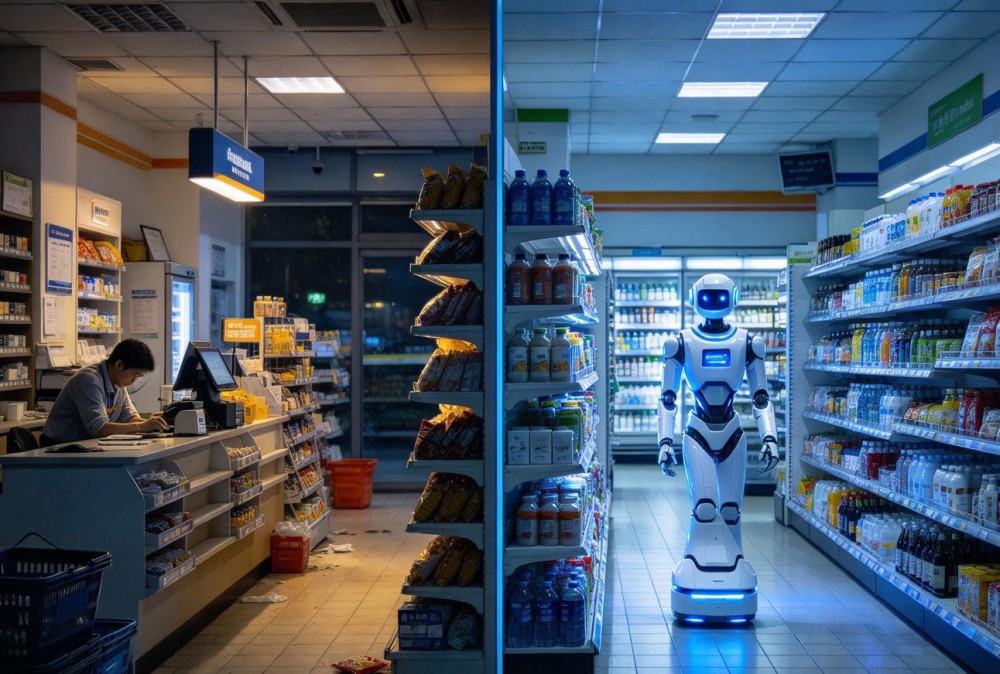
A quiet shift is underway in the world's stores and hotel lobbies. The machine that greets you at the entrance, audits a half-empty shelf at 2 a.m., or hands you a freshly poured coffee may not be a tablet on a stick — it may be a humanoid robot, upright, two-armed, and built to move through spaces designed for people. The momentum behind this trend will be on full display at The 3rd Hangzhou International Humanoid Robot and Robot Technology Exhibition 2027 (HRTE 2027), taking place May 27–29, 2027, at the Hangzhou Grand Convention and Exhibition Center in Zhejiang Province, where retailers, technology vendors, and investors are expected to converge on the question of what a "robot colleague" actually looks like on the sales floor. This is no longer a science-fair curiosity. Across Asia and beyond, humanoids are being trialed in retail and hospitality as a pragmatic answer to one of the industry's most stubborn problems: a labor model that is simultaneously too expensive and too fragile.
Retail and hospitality have always run on people. Yet industry observers note that the sector is caught in a paradox that has only intensified over the past several years. On one side, shifts are hard to fill — particularly night, overnight, and weekend windows where staffing thinness collides with the need to keep a store running. On the other, turnover in repetitive roles such as shelf stocking, floor cleaning, and basic customer assistance remains persistently high, driving constant re-training costs and inconsistent service quality.
At the same time, retailers face dual pressure that is difficult to resolve with conventional levers. They are being asked to cut operating cost while simultaneously upgrading the in-store experience, because physical retail's last defensible advantage over e-commerce is exactly that — the experience. According to public reports, wage pressure in service sectors has risen across many markets, and the pool of workers willing to take on low-skill, high-repetition overnight work has not kept pace. The result is a structural opening: a role that is dull, dirty, or difficult to staff, yet genuinely valuable when done well. That is precisely the niche humanoid robots are being positioned to fill.
The early deployments are less about replacing the friendly store manager and more about absorbing the tasks nobody wants to do at 3 a.m. Several task families are being trialed in real and near-real environments:
Greeting and wayfinding. A humanoid stationed near the entrance can welcome shoppers, answer "where is the electronics section" type questions, and route foot traffic. The value is partly functional, partly psychological: a human-shaped presence reads as attended and cared-for.
Shelf auditing and replenishment. Using onboard vision, a robot can walk the aisles, detect gaps and misplaced items, flag planogram violations, and in some setups retrieve a tote or push a light restock. Industry estimates suggest that a meaningful share of out-of-stock incidents is caused not by supply shortages but by shelf execution failures — exactly the kind of problem a tireless walker can catch.
Light food and beverage preparation. In cafe-style formats, humanoids are being tested for tasks like grinding, pouring, and plating — repetitive motions with a clear sequence, well suited to a dexterous arm under supervised autonomy.
Fitting-room and checkout assistance. Helping shoppers find sizes, carrying items, or guiding them through a self-checkout flow reduces friction at the two moments where retail most often loses the sale.
Night unattended floor patrol. Perhaps the clearest near-term use case: a store that closes to humans but stays "watched" by a mobile, human-shaped sentinel that can navigate steps, inspect shelving, and flag anomalies without a full security team on site.
None of these is exotic on paper. What is new is the convergence of a body shape that fits the built environment with software capable enough to attempt the job.
It is important to be clear about what a humanoid is not. Retail and hospitality have already automated heavily, and the humanoid is not here to demolish that installed base. Self-checkout kiosks, Autonomous Mobile Robots (AMRs) for goods-to-person fulfillment, and electronic shelf labels (ESLs) are already mainstream. A goods-to-person AMR is brilliant at moving totes through a warehouse; it is useless at climbing the two steps into a boutique and handing a customer a shopping bag. An ESL updates prices instantly; it cannot notice that the display has collapsed.
This is the humanoid's unique value proposition: it fills the "human-shaped gap" — the set of tasks that require walking through a space built for people, reaching across a shelf, climbing a low step, and interacting naturally with shoppers. Rather than competing with dedicated automation, the humanoid sits on top of it, extending the reach of systems that are otherwise bolted to the floor or confined to a defined path. The most credible pilots treat the humanoid as the flexible last meter, not as a replacement for the efficient machinery already doing the heavy lifting.
Conference demos are seductive and frequently misleading. The genuinely hard problems are worth naming plainly.
Shelf and object vision recognition. Recognizing a missing SKU under messy, glare-filled, constantly shifting retail lighting is far harder than recognizing a face in good light. Models must generalize across packaging changes, promo stacks, and occlusion — and they must do so without constant human labeling.
Multimodal interaction. A useful floor robot must parse speech, gesture, and context together: a shopper points and asks "do you have this in blue?" The system has to resolve the referent, search availability, and respond helpfully — all in a noisy environment.
Grasping and tote handling. Dexterous manipulation of retail objects — soft packaging, irregular shapes, stacked totes — remains the frontier. Current systems favor constrained, repeatable picks over open-ended "grab anything."
Human-robot coexistence safety. On a live floor, collision avoidance is non-negotiable, backed by e-stop mechanisms, speed and proximity zoning, and conservative failure behavior. A robot that freezes safely is worth more than one that is fast and unpredictable.
Industry observers note that the gap between a controlled demo and a 40-hour weekly deployment is where most of the real engineering lives. The credible players are those transparent about fallback behavior when the robot is unsure.
How retailers acquire these machines matters as much as what the machines do. Two models dominate the conversation.
Direct purchase appeals to large operators who want full control, deep integration with existing store systems, and the ability to customize. The downside is capex and the burden of maintenance, updates, and eventual decommissioning.
Robotics-as-a-Service (RaaS) leasing lowers the barrier dramatically: a monthly fee covers the hardware, software updates, and support, turning a capital expense into an operating expense and letting a retailer pilot without betting the budget. For skeptical CFOs, RaaS is the bridge from "interesting" to "tryable."
Either way, ROI thinking tends to cluster around four levers: labor-hour savings on hard-to-staff shifts, sales-floor productivity from better shelf execution, night coverage without a full overnight team, and consistency — the robot never has a bad morning. According to public reports, retailers evaluating these deployments increasingly ask for pilot metrics tied to specific shifts rather than笼统 efficiency claims, a sign the category is maturing past hype.
A robot that watches a store also watches the people in it, and that demands a clear compliance boundary. The guiding principle for customer-facing vision should be data minimization: capture only what the task requires, and avoid persistent identification of individuals unless there is a explicit, lawful basis. Where behavioral data is useful — for example, understanding foot-traffic patterns near a promotion — the healthier architecture is on-device desensitization, where faces and other identifiers are blurred or abstracted at the edge before anything leaves the robot.
Industry estimates suggest that regulatory expectations around biometric and behavioral data are tightening in multiple jurisdictions, which makes privacy-by-design not just ethical but commercial hygiene. Retailers that treat the camera as a shelf-analysis tool, not a customer-surveillance tool, are far more likely to keep public trust — and to avoid the reputational cost of a privacy misstep that a humanoid demo cannot survive.
There is a reason the conversation keeps returning to China, and specifically to the Yangtze River Delta. The country combines a complete supply chain for robotics components — actuators, sensors, batteries, and control systems — with dense, high-traffic scenarios that generate the deployment volume any learning system needs. Equally important is a strong new-retail DNA: a retail culture already comfortable with app-driven stores, unmanned formats, and tight integration between online and offline commerce.
Hangzhou sits at the heart of this ecosystem. As the cradle of new-retail thinking — the Alibaba and Hema-style formats that reimagined the store as a logistics and experience node rather than just a point of sale — the city is a natural stage for humanoid retail trials. The surrounding Yangtze River Delta offers both the manufacturing depth and the scenario density to turn prototypes into weekly routines. It is fitting, then, that HRTE 2027 will gather this concentration of capability in one place, giving retailers and vendors a rare chance to compare approaches side by side.
The implications radiate outward from the store itself.
For retailers, the near-term play is not "fire humans, hire robots" but "cover the gaps." Start with night patrol and shelf auditing, measure labor-hour savings, then expand to interaction roles where the experience payoff is clearest.
For brands, a humanoid on the floor is a new surface for engagement — a controlled, on-brand ambassador that can demo a product or guide discovery, provided the brand respects the line between helpful and intrusive.
For equipment vendors, the differentiator is no longer the body alone but the reliability stack: safety certification, fleet management, and graceful failure. The winners will sell uptime, not novelty.
For investors, the signal to watch is unit economics at scale and the shift from capex to RaaS recurrence. Where pilots convert to multi-store leases, a category becomes a market.
Humanoids will not make retail "human-free." If anything, the early evidence suggests the opposite: by absorbing the dull, dangerous, and difficult shifts, they free human staff to do the human work — the empathy, the judgment, the moments that build loyalty. The stores that get this right will not look like science fiction. They will simply look well-run, at 2 a.m. as well as at 2 p.m.
That is the future HRTE 2027 invites the industry to examine up close. The 3rd Hangzhou International Humanoid Robot and Robot Technology Exhibition 2027 (HRTE 2027), taking place May 27–29, 2027, at the Hangzhou Grand Convention and Exhibition Center in Zhejiang Province, is where retailers, brands, equipment vendors, and investors can move from watching the trend to piloting it — and where the practical question of the "human-shaped gap" gets answered, one shift at a time.