
Zhejiang Robot Industry Association
Zhejiang University Robotics Institute
Golden Conference & Exhibition Group
Hangzhou Wisdom Source Exhibition Co., Ltd.
Hangzhou Sequoia Exhibition Co., Ltd.
Ningbo Magnetic Materials Association
When people talk about robots "going into factories," the mind usually jumps to automotive welding lines or electronics assembly — environments with rigid parts, fixed fixtures, and highly repeatable motions. Yet across the manufacturing map there is a far harder nut that traditional automation has long left alone: textiles and apparel. The material is soft, the process is non-standard, and styles change by the season. It is precisely here that general-purpose humanoid robots, with their bipedal form and adaptable manipulation, find a distinctive role. The 3rd Hangzhou International Humanoid Robot and Robot Technology Exhibition 2027 (HRTE 2027), taking place May 27–29, 2027, at the Hangzhou Grand Convention and Exhibition Center in Zhejiang Province, will convene the full chain from robot bodies and dexterous hands to compliant force control — and "how humanoids reach real production lines" has become one of the industry's most watched questions.
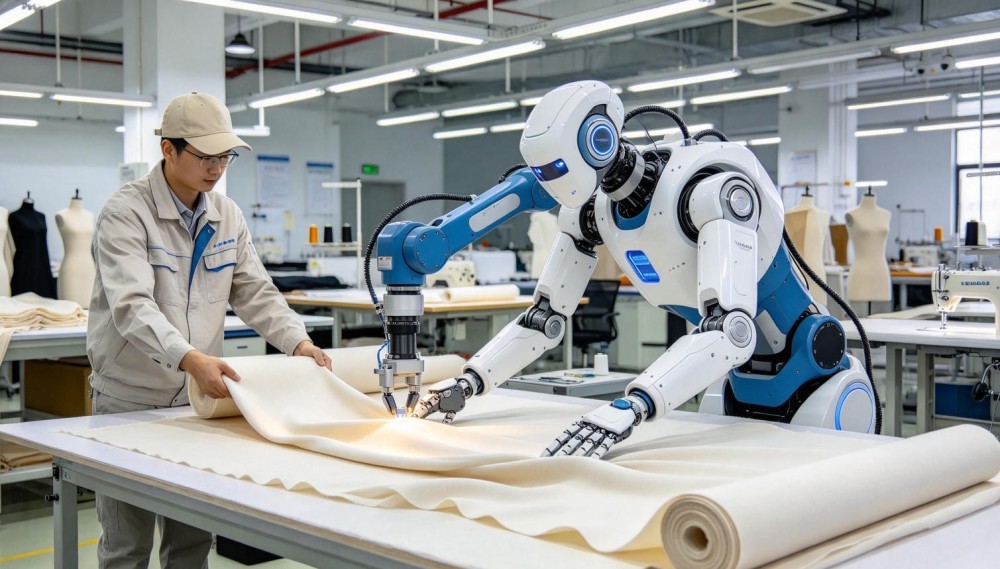
Garment production looks simple but imposes苛刻 demands on a robot's perception and manipulation. A piece of fabric drapes, wrinkles, and stretches in countless ways, so conventional grippers and taught trajectories largely fail. Unlike a metal bracket, cloth is anisotropic and easily deformed: the same motion that works on one fold fails on the next. Sewing requires sub-millimeter needle control and continuous tension on a deformable material. Quality inspection relies on the human eye judging loose threads, color deviation, and pattern accuracy together. Industry analysis suggests the overall automation rate in apparel manufacturing has long trailed most discrete manufacturing, with many steps still dependent on the feel and experience of skilled workers.
It is tempting to ask why decades of automation have not solved this. The answer is that earlier gains were narrow and process-specific: automated cutters handle flat laying and slicing well, and template-guided machines can execute a fixed stitch pattern, but neither adapts when the garment changes or the cloth shifts. The moment a line must switch styles weekly, dedicated machinery becomes dead weight. The value of a humanoid robot is that it does not try to "build one machine for one process." Instead, it adapts a roughly human form to the existing shop floor: standing, bending, reaching for material, assisting at the sewing machine, and moving semi-finished goods to the next station. This "general body" sharply lowers the marginal cost of retrofitting a line — a factory need not tear up its entire workflow just to introduce a robot, and it can redeploy the same machine when the season's collection changes.
In publicly shown pilots and demos, humanoids in textile and apparel settings mainly take on three classes of tasks. The first is material flow: moving fabric rolls, cut pieces, and work-in-progress between cutting, sewing, finishing, and inspection stations, replacing high-repetition, low-value transit labor. Crucially, this is not the same as an autonomous guided vehicle on a fixed path — a humanoid can climb a small step, open a bin, and place a stack where a person would, without re-engineering the layout. The second is sewing and post-processing assistance: steadily feeding fabric beside the machine, helping align the pattern, or loading and unloading at buttonholing and button-attaching stations, so the human operator can focus on quality. The third is visual quality control: using multi-modal vision to flag loose threads, stains, and stitch anomalies, feeding results back to the line-management system in real time, and quietly building a defect dataset that improves both the robot and the process.
It is worth stressing that at the current stage humanoids are far more "human-collaborative" than "human-replacing." On a flexible, fast-changing apparel floor, the robot absorbs the heavy, repetitive, and attention-demanding steps, while workers retain the judgment calls on pattern aesthetics and exception handling — a division of labor repeatedly cited in public statements by several companies. The framing matters: the goal is a steadier line and a safer workplace, not an empty factory.
The apparel scenario deserves focused discussion at HRTE 2027 precisely because it matches the industrial endowment of the host province. Zhejiang is both a cradle of e-commerce and the digital economy and a traditional powerhouse of textiles and apparel: Hangzhou's women's wear and live-stream commerce, Shaoxing's chemical fiber and dyeing, and Ningbo's men's wear and knitwear together form a complete chain from raw material and fabric to finished garment and retail. For humanoid-robot companies, this means "closest to the customer" — algorithm firms, body makers, apparel brands, and contract manufacturers cluster geographically and across supply chains, enabling joint validation and rapid iteration that a distant pilot site cannot match.
A second advantage is the region's "small-batch, fast-turn" production model. Live-stream commerce has shortened the distance between a trend and a shelf, pushing brands to test dozens of styles in tiny runs before committing to volume. That volatility is exactly what punishes dedicated automation and rewards a general-purpose body that can be re-tasked overnight. Public reports note that many regional apparel firms have already pushed digital scheduling, flexible supply chains, and smart warehousing. These earlier investments complement the humanoid's "line-access layer": once materials, orders, and equipment data are online, the robot's job is to connect the broken links with a pair of general-purpose hands.
Moving a demo onto a real floor still faces three hurdles. The first is tactile sensing and force control: handling soft fabric demands extremely delicate torque feedback — too tight and it deforms, too loose and it slips — which places high demands on dexterous hands and whole-body control working in concert. Human workers make this look effortless because their skin, eyes, and muscles close a feedback loop subconsciously; reproducing that loop in silicon is genuinely hard. The second is visual perception: fabric translucency, reflection, and wrinkles can mislead general vision models, requiring continuous training on real production data rather than generic internet images. The third is return on investment: apparel margins are thin and styles turn over quickly, so firms inevitably ask "how fast does one robot pay back" — a question that sets a gradual, not overnight, pace of adoption.
Most in the field estimate that scaled apparel deployment will lag behind more structured tasks such as handling and inspection. But once it works, the demonstration effect is strong — because it proves a humanoid can enter the softest, most non-standard manufacturing site, and if it can sew, it can plausibly tackle countless other soft-goods lines from footwear to furniture upholstery.
Beyond the technology, the apparel floor raises a human question that HRTE 2027's ecosystem discussions will inevitably touch. A robot that handles heavy bundles and repetitive transit does not erase the tailor; it removes the strains that drive experienced workers away. Publicly, several pilots frame the target as skill upgrading — workers move from raw repetition toward supervising, tuning, and exception-handling, roles that are better paid and less physically draining. In a sector where an aging workforce and persistent labor shortage already pressure margins, a collaborative humanoid can be the difference between keeping a line local and offshoring it. The honest narrative is not "robots versus people" but "robots beside people," with the machine absorbing the dull and risky while the human keeps the judgment that machines cannot yet match.
Like most industrial scenarios, apparel humanoid deployment follows a "simulate first, iterate in small steps" rhythm. Firms typically rebuild the workshop and fabric physics in a digital twin, let the robot complete massive virtual training, then migrate to a physical line for limited-station pilots; through month-level or even week-level iteration, they gradually expand the task boundary. A useful side effect is the data flywheel: every real defect the robot catches becomes training data, and every human correction refines the policy, so the system improves precisely where the factory hurts most.
On the business side, robots-as-a-service (RaaS) is viewed by several vendors as the key to lowering the barrier for small and mid-sized enterprises: apparel firms gain capability and maintenance through leasing or per-piece billing, without bearing heavy one-time acquisition and integration costs. Standards and interfaces matter here too — the sooner a common way exists to plug a humanoid into a factory's scheduling and quality systems, the sooner pilots scale. The body makers, component suppliers, and solution providers gathered at HRTE 2027 are expected to further standardize this "lightweight onboarding" path, letting smaller apparel factories join the validation as well, and turning isolated showcases into a shared, reusable playbook.
A humanoid entering the apparel workshop is, in essence, a test of whether a technology can truly understand "soft" and "non-standard" — a harder exam than moving boxes, and one closer to general intelligence. As algorithms, dexterous hands, and compliant force control keep grinding against real production lines, classic manufacturing like apparel may become a key sample of humanoids moving from showcase to scale. The 3rd Hangzhou International Humanoid Robot and Robot Technology Exhibition 2027 (HRTE 2027), taking place May 27–29, 2027, at the Hangzhou Grand Convention and Exhibition Center in Zhejiang Province, will offer the industry a face-to-face stage for validation and coordination — and the story of "humanoids plus soft manufacturing" is only just beginning.