
Zhejiang Robot Industry Association
Zhejiang University Robotics Institute
Golden Conference & Exhibition Group
Hangzhou Wisdom Source Exhibition Co., Ltd.
Hangzhou Sequoia Exhibition Co., Ltd.
Ningbo Magnetic Materials Association
In the first half of 2026, the world's factories, labs, and trade shows quietly crossed a threshold that would have sounded like science fiction three years ago: humanoid robots began shipping by the tens of thousands. The surprising part was not that the robots existed. It was where they were built. According to a World Robot Conference (WRC) report, China delivered more than 40,000 humanoid units in the first six months of 2026 — roughly 97% of all humanoid robots shipped anywhere on Earth in that period.
That number is real, and it is staggering. But like most round numbers in fast-moving industries, "97%" is also a story that hides as much as it reveals. It tells you who is building the machines. It does not yet tell you whether the machines are actually working for a living.
This is the story of how China built the world's densest humanoid-robot supply chain in under a decade — and why the most important question for the industry is no longer "can China make them?" but "who, exactly, is buying them?"
The 97%: a number, and a caveat
The headline figure comes from the WRC conference report: 40,000+ units shipped in H1 2026, ~97% of global volume. Beijing's own Ministry of Industry and Information Technology (MIIT) added fuel on July 7, estimating that full-year 2026 output could exceed 100,000 units. External observers are only slightly more conservative. Morgan Stanley projects China will produce roughly 50,000 humanoids in 2026 and as many as 440,000 by 2030.
Read together, the numbers sketch a trajectory: from a standing start, China is on pace to produce humanoid robots at a scale measured in six figures within a single year, and to a level approaching half a million annually by the end of the decade. For context, the global conversation about humanoids as recently as 2023 was still about hand-built prototypes costing as much as a luxury car.
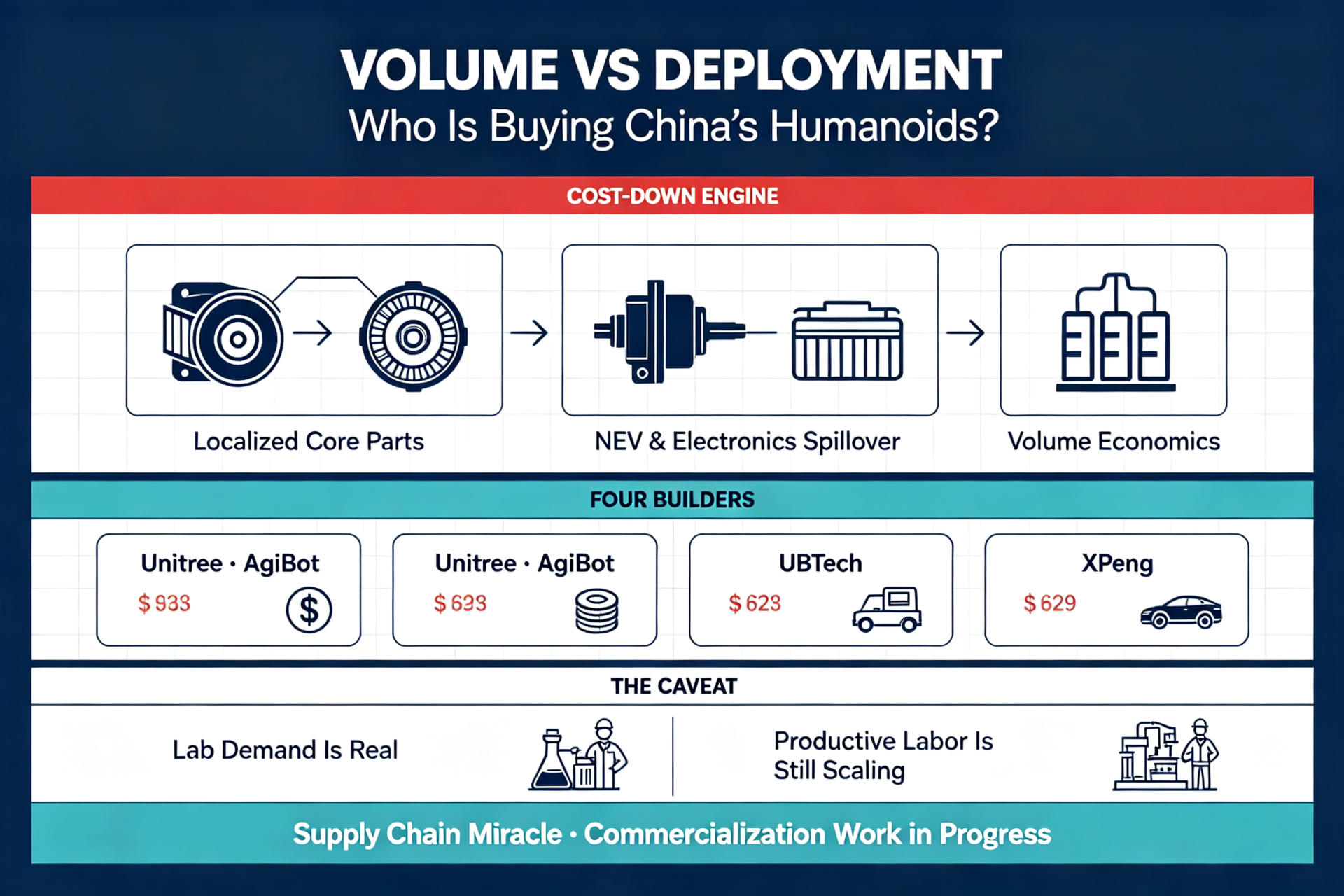
But here is the honest caveat that anyone underwriting this market should keep in mind. Industry analysis consistently notes that a large share of Unitree's H1 shipments — the single largest Chinese volume player — went not to automotive plants or warehouses, but to universities, research institutes, and developers buying units for training, benchmarking, and R&D. In other words, the biggest "customer" for humanoid robots in China today is still the laboratory. Volume is real. Commercialization into paid, productive labor is still a work in progress. We will return to this distinction, because it is the difference between a supply-chain miracle and a supply-chain bubble.
The cost-down engine
If there is one mechanism that explains the 97%, it is price collapse — and the manufacturing base that made it possible.
Unitree's humanoid unit price fell from ¥593,400 in 2023 to ¥167,600 by the third quarter of 2025. Its G1 model sells for around ¥99,000, and the newer R1 comes in under $5,000. A machine that was a six-figure investment three years ago is now, in its entry form, cheaper than many used cars. That is not a marginal discount. That is a category redefinition.
Three forces drove it:
1. Core-part localization. The components that once locked humanoid builders into foreign suppliers — precision reducers, servo systems, controllers — broke their import dependence. Domestic suppliers now produce the high-value internals at a fraction of prior cost.
2. Supply-chain spillover from neighboring industries. This is the quiet superpower. China's humanoid supply chain is not built from scratch; it is shared with the new-energy-vehicle (NEV) and consumer-electronics industries. Battery packs, motor control, sensors, lithium cells, and contract-manufacturing capacity that were perfected for EVs and smartphones were repurposed for robots almost overnight. The robot did not need its own supply chain. It inherited one.
3. Volume economics. Once a few thousand units per quarter became normal, fixed R&D and tooling costs spread thin. Every additional 10,000 units pushed the marginal cost down further, creating a flywheel that overseas competitors — starting from lower volumes and without a co-located NEV/electronics base — struggle to match.
The result is a structural cost advantage that is difficult to reverse. You cannot easily out-subsidize a supply chain that is already amortized by the world's largest EV and electronics industries.
The players building the 97%
Behind the aggregate number is a small set of companies turning the supply chain into shipped product.
Unitree (Hangzhou) is the volume leader and, by industry accounts, the only major humanoid maker currently profitable. It shipped 5,500+ units in 2025 and has set a 2026 target of roughly 20,000. Its strategy — aggressive pricing, consumer-accessible models, and developer adoption — is exactly why so many of its units land in labs and R&D shops.
AgiBot / Zhiyuan (Shanghai) hit a symbolic milestone when its 15,000th unit rolled off the line in June 2026, just ~3 months after its 10,000th. The company is pursuing a Hong Kong IPO reportedly valued at HK$40–50 billion, and carries a founder profile with deep Huawei ties. AgiBot represents the "national champion" path: scale, state-adjacent credibility, and capital-markets ambition.
UBTech (Shenzhen) focuses on the industrial floor. Its Walker S2 features a 3-minute autonomous battery swap — a deceptively important capability, since it lets a robot work in near-continuous shifts without human intervention. UBTech has deployed at BYD and Foxconn and is targeting ~10,000 units of capacity in 2026. This is the clearest signal of humanoids moving from demo to deployment.
XPeng (IRON) is the wild card from the auto sector. The carmaker targets 1,000 units per month by the end of 2026 and has begun placing robots in its own retail stores — a vertical integration play where the showroom robot is both product and proof point.
Together, these four illustrate the breadth of the Chinese push: a profitable price leader, a capital-markets champion, an industrial specialist, and an automaker-cum-robot-builder. Different strategies, one shared supply chain.
Volume is not commercialization
This is the part of the 97% story that deserves more airtime.
A robot shipped to a university lab is a very different economic object from a robot paid to assemble a phone. The first is a research instrument — its value is in what it teaches the people around it. The second is labor — its value is in the work it displaces or augments. China is demonstrably winning the first race. The second race is just beginning, and the early deployment data is promising but narrow: UBTech at BYD and Foxconn, XPeng in showrooms, AgiBot's rapid unit ramp. Real, but not yet the tidal wave the shipment totals might imply.
There is a risk embedded here. If a large fraction of shipped units are absorbed by R&D and education rather than productive deployment, then "97% of global shipments" partially measures the size of China's robotics-research ecosystem — which is genuinely enormous — rather than the readiness of humanoids for the open market. That is still a supply-chain triumph. It is not yet a commercialization one.
The constructive reading: China is using its supply chain to manufacture the training data and talent the next phase will require. Every lab unit is a developer learning to write for humanoids, a dataset growing, a failure mode documented. The 97% may turn out to be less a measure of today's workforce and more an investment in tomorrow's.
The geopolitical and material undercurrent
No account of China's humanoid dominance is complete without the materials question — and here the leverage cuts both ways.
In April 2025, China imposed export controls on rare-earth elements and related processing. Rare earths are the lifeblood of precision motors, magnets, and actuators inside every humanoid robot. The controls strengthened Beijing's hand abroad: it is hard to build a servo motor without the magnets China refines. But the same concentration is a reminder of fragility — for China as much as for anyone. A supply chain that depends on a narrow set of materials is a supply chain with a known single point of failure. The controls are, in that sense, a double-edged sword: geopolitical leverage today, concentration risk tomorrow.
For Western buyers and builders, the lesson is strategic rather than tactical. The 97% is not merely a scoreboard of who shipped more boxes. It is a map of where the industrial capability now lives — and a prompt to ask whether redundant, friendly-shored supply chains for motors, magnets, and reducers need to be built before humanoids become critical infrastructure.
Where the ecosystem comes into view
The strength of this supply chain is easiest to grasp in one place: Shanghai International Humanoid Robot and Robotics Industry Chain Exhibition (HRIE 2026), held December 9–11, 2026, at the Shanghai New International Expo Centre (SNIEC). It is where the companies behind the 97% — Unitree, AgiBot, UBTech, XPeng and the long tail of component makers — concentrate under one roof, and where the gap between "shipped" and "deployed" gets measured in real demos rather than shipment reports.
The bottom line
China's 97% share of humanoid shipments in H1 2026 is not an accident and not a stunt. It is the output of a cost-down engine built on localized core parts and a supply chain borrowed from the world's largest EV and electronics industries — operated by a handful of companies scaling faster than any Western peer. That is a genuine, durable advantage.
But the honest investor, engineer, or policymaker should read the 97% with both eyes open. Volume is real; the lab is still the biggest customer; rare-earth concentration is both a weapon and a warning. The question the next twelve months will answer is simple: does the supply chain that built 40,000 robots in six months also build the demand that turns them into workers?