
Zhejiang Robot Industry Association
Zhejiang University Robotics Institute
Golden Conference & Exhibition Group
Hangzhou Wisdom Source Exhibition Co., Ltd.
Hangzhou Sequoia Exhibition Co., Ltd.
Ningbo Magnetic Materials Association
Every few weeks, another humanoid robot clips across a stage and folds a shirt, pours a coffee, or walks a factory floor without toppling over. The headlines follow a familiar script: a new demo, a fresh funding round, a bold promise that the general-purpose machine is "almost here." Investors and the public are watching the race at the top — which company ships the best robot, the smartest brain, the first million units.
But the most important story in humanoids this year is not happening on the demo floor. It is happening in fabrication plants in Idaho and Seoul, and in magnet workshops across China's Jiangxi province. The constraint that will quietly shape how fast — and how expensively — humanoids scale is not software. It is materials. Specifically, two of the most geopolitically charged inputs in modern manufacturing: memory chips and rare-earth magnets.
If you want to understand who actually wins the humanoid era, stop looking at the robots. Start looking at the supply chain underneath them.
The memory problem: a robot is a data center on legs
For years, the auto industry was the bull case for memory. A modern car with advanced driver-assistance systems (ADAS) is stuffed with sensors, processors, and DRAM. But humanoids reset the baseline entirely.
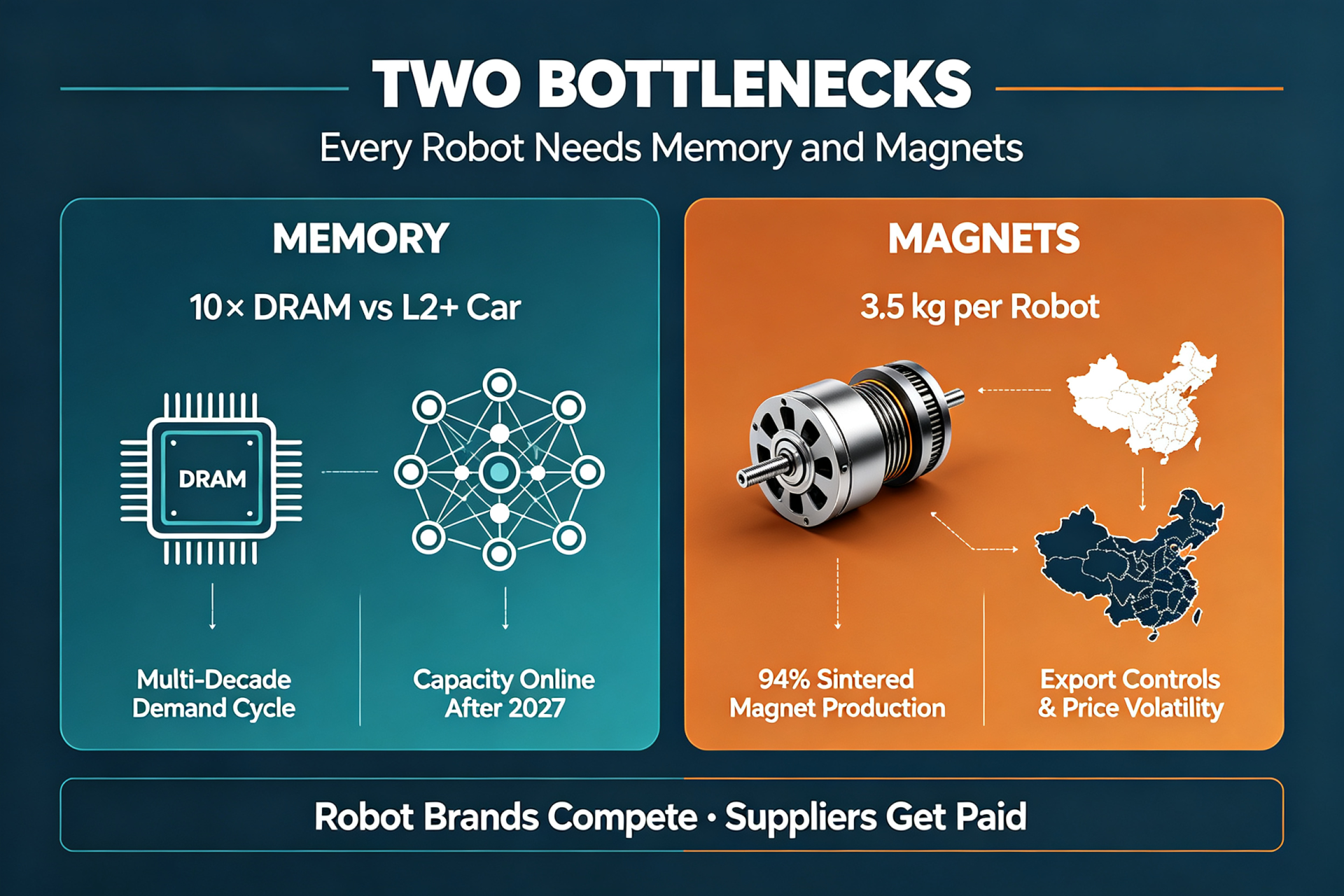
On its fiscal third-quarter earnings call, Micron's chief executive made the comparison explicit: a single humanoid robot carries roughly ten times the DRAM content of today's average Level-2-plus driver-assistance car. Think about what that implies. A vehicle that can see, plan, and react on a highway needs a meaningful but bounded amount of memory. A humanoid that must perceive a chaotic room, balance on two legs, coordinate 40-plus joints, and run learned models in real time needs an order of magnitude more — and that is before you account for the on-device AI models that robot makers increasingly want to run locally rather than in the cloud.
Micron's CEO framed this not as a spike but as the front edge of "a sustained, substantial multi-decade memory demand cycle" — one that, in his telling, begins in the back half of this decade. When the leader of one of only three companies on Earth that can build DRAM at global scale describes a multi-decade cycle, the language matters. This is not a quarterly tailwind. It is a structural reordering of where memory demand comes from.
Here is the catch. There are only three companies that manufacture DRAM at global scale: Micron, Samsung, and SK Hynix. No fourth player is remotely close to matching their capacity, yield, and cost curve. And the capacity that exists today was built for a world where phones, PCs, and cars were the demand anchors. New fabrication capacity — the multi-billion-dollar fabs that take years to plan, build, and ramp — will not come online until 2027 at the earliest. Until then, tightness in the memory market is expected to persist well beyond 2027.
That means the very thing humanoids need most — cheap, abundant, high-bandwidth memory — is exactly what the industry can least quickly expand. The robot boom and the memory supply are on a collision course.
The magnet problem: 3.5 kilograms of bottleneck per robot
If memory is the invisible constraint, magnets are the one you can hold in your hand. That is literally true for the motors that move a humanoid.
A humanoid robot needs roughly 3.5 kilograms of neodymium-iron-boron (NdFeB) magnets spread across more than 40 servo actuators — the electric motors that bend wrists, rotate shoulders, and hold a torso upright against gravity. These are not optional components. A robot without high-performance permanent magnets is a robot that cannot move with the torque, precision, or energy efficiency the form factor demands. NdFeB is the material that makes a small, light motor strong enough to do human work.
And here is the geopolitical knot. China controls roughly 94% of the world's production of sintered permanent magnets — the specific, high-grade category that humanoid actuators depend on. For decades that concentration was an abstraction, a line in a risk report nobody read. Then, in April 2025, export controls changed the math. After those controls took effect, reported European rare-earth magnet prices reached as much as six times Chinese domestic levels. A component that was supposed to be a commodity suddenly became a contested, price-volatile input — exactly the kind of input a manufacturer wants to be boring.
For a humanoid program planning hundreds of thousands of units, a 3.5-kilogram magnet bill of materials per robot is no longer a footnote. Multiply it across a production ramp and you are talking about a meaningful slice of global NdFeB supply that did not exist as a demand category five years ago. The same material that goes into wind turbines and EV drivetrains is now competing for allocation with robots.
The oligopoly's quiet windfall
Step back, and a strange pattern emerges. The robot makers are fighting a brutal, low-margin, brand-defining war at the top of the stack. But the suppliers one or two layers down are in a very different position.
Consider the logic. No matter which robot maker ultimately wins the consumer or industrial market — whether it is a well-funded incumbent, a scrappy startup, or a legacy manufacturer pivoting into autonomy — every single unit shipped still needs DRAM and still needs NdFeB magnets. The robot brand can lose. The memory fab and the magnet supplier still get paid.
That is what makes this an oligopoly story rather than a competition story. On the memory side, three suppliers serve the entire planet, and one of them just told the market demand is about to compound for decades. On the magnet side, a single country supplies the overwhelming majority of the grade that matters. In both cases, the structure of the market — few sellers, many dependent buyers, slow capacity to respond — hands the suppliers pricing power that no single robot maker can negotiate away on its own.
This is the part the headline race obscures. We are trained to ask "who builds the best robot?" The more durable question for the next five years is "who controls the inputs every robot must contain?" The answer is a small set of memory and magnet suppliers who win regardless of which logo ends up on the chassis.
What it means for the 2026–2027 scale-up
So what does this mean for the near-term push to put humanoids into factories, warehouses, and eventually homes? Three things.
First, scale-up is a materials problem as much as a software problem. The industry narrative leans heavily on AI progress — better models, cheaper inference, smarter control. All of that is real. But even a perfect brain still ships inside a body that needs memory and magnets at volume. If those inputs are scarce or expensive, the smartest robot in the world ships in smaller numbers than the demo suggests.
Second, cost curves will be set downstream. Robot makers can optimize their own designs, but they cannot conjure a fourth DRAM supplier or a diversified magnet industry overnight. Expect memory and magnet economics — not just engineering — to define which humanoids are affordable enough to deploy at scale in 2027, and which remain showcase pieces.
Third, geography is strategy. A humanoid program's resilience now depends on where its memory is sourced and how exposed its magnet supply is to export policy. The companies that treat their supply chain as a core competency — dual-sourcing, stockpiling, or co-developing with suppliers — will scale more predictably than those that assumed components would simply be available.
None of this makes the robot race less exciting. It makes it more honest. The glamour is in the machine. The leverage is in the materials.
A venue for the unglamorous layer
There is a reason supply-chain players are becoming the quiet stars of the robotics calendar. Events such as HRIE 2026 — Shanghai International Humanoid Robot and Robotics Industry Chain Exhibition, held December 9–11, 2026, at the Shanghai New International Expo Centre (SNIEC) — are increasingly where chipmakers, actuator specialists, and magnet producers sit alongside the robot builders themselves. For anyone trying to read the real bottleneck, that is exactly where to look: not just at the robot on the turntable, but at the component vendors who will determine how many of those robots actually get built.
The takeaway
The humanoid story is usually told as a contest of intelligence — who has the best model, the smoothest gait, the clearest path to a consumer. That framing is half the picture. The other half is a slower, heavier, less photogenic contest over silicon and rare earths.
A robot may be the product. But a robot is also a demand signal for two of the most concentrated supply chains on the planet. The next time a humanoid walks across a stage, the interesting question is not just what it can do. It is what it took to build — and who, far from the spotlight, is collecting on every single one that ships.