

Zhejiang Robot Industry Association
Zhejiang University Robotics Institute
Golden Conference & Exhibition Group
Hangzhou Wisdom Source Exhibition Co., Ltd.
Hangzhou Sequoia Exhibition Co., Ltd.
Ningbo Magnetic Materials Association
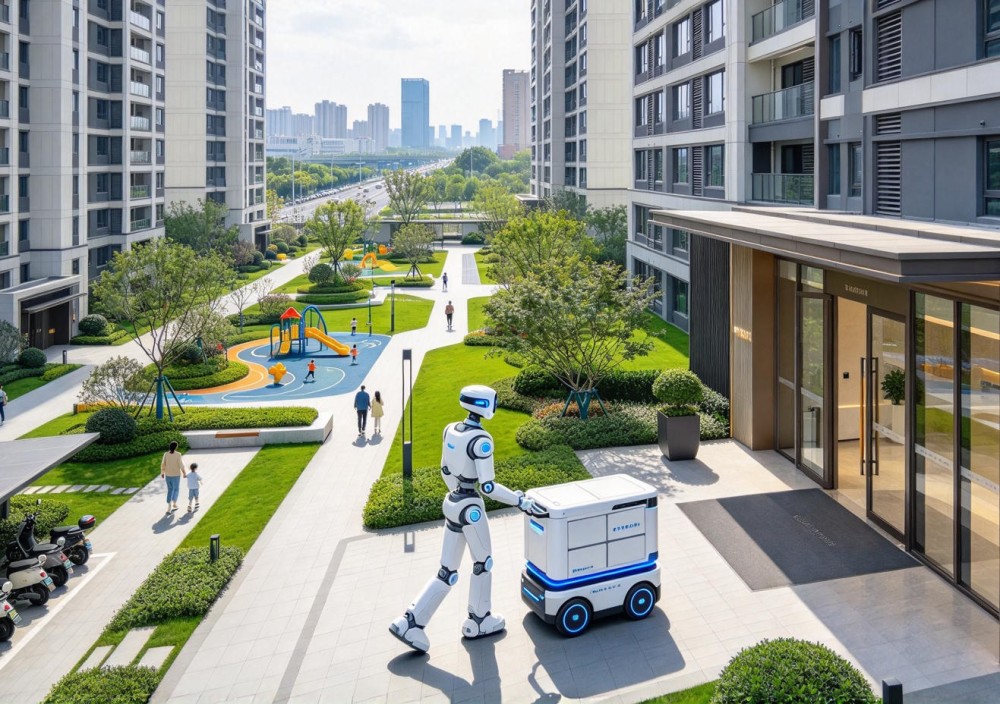
As The 3rd Hangzhou International Humanoid Robot and Robot Technology Exhibition 2027 (HRTE 2027), taking place May 27–29, 2027, at the Hangzhou Grand Convention and Exhibition Center in Zhejiang Province, draws near in Hangzhou, one scenario that sits closest to ordinary people—yet is most easily overlooked in industry narratives—is being reopened: the residential communities we pass through every day. Can parcels and meals be delivered to the apartment door? Is the elderly resident living alone doing well? Who continuously watches over the safety and environment of shared spaces? As general-purpose robot bodies acquire stable walking, voice interaction, and autonomous navigation, the community—smallest unit of the city—is becoming the "last mile" proving ground for humanoids to move from demonstration halls into daily life.
Communities are where urban population density is highest, service needs are finest-grained, and human-machine contact is most frequent. A mature residential compound generates a flood of "small but rigid" tasks every day: parcel delivery, meal drop-off, waste-sorting guidance, shared-area patrol, visitor reception, resident inquiries, and—increasingly valued—care check-ins for seniors living alone.
These tasks share common traits: non-standard, dispersed, unpredictable in timing, and heavily dependent on human labor. According to publicly available information, the property-management industry has long struggled with recruitment difficulty, high staff turnover, and understaffed nights and holidays, while residents' expectations for speed and quality keep rising. Pinning people to repetitive, low-value errands and patrols is neither sustainable nor a good use of human capability. The pressure is not unique to any one country: across many economies, property and facility services face the same squeeze of rising labor costs, thin margins, and an aging service workforce, which is why community service is quietly becoming one of the most universal testing grounds for embodied automation.
This is precisely the entry point for humanoid robots: they need not reshape a community's physical structure, but can use a general body that "walks, sees, converses, and rides elevators" to fill the service gaps that are "frequent yet trivial."
Placed inside a community, a humanoid robot's roles roughly fall into three categories.
The first is "running errands"—last-leg delivery and to-the-door service. Beyond parcel lockers and delivery platforms, a large volume of "final tens of meters" demand remains: carrying bulky parcels upstairs, bringing meals to the doorstep, urgent medicine runs, distributing groceries residents asked someone to collect. A robot that rides elevators autonomously, calls access control, and completes face-to-face handover can push delivery from "pick-up at the point" to "drop-off at the door," a particular benefit for residents with limited mobility. It also changes the economics for couriers: instead of parking, queuing, and searching building by building, they can hand a batch to the robot at the gate and move on, with the machine handling the vertical climb and the final handover.
The second is "patrolling"—shared-area security and environmental inspection. Nighttime compound patrol, fire passages kept clear, suspicious loitering, facility damage reports, puddles and hazard identification—work that once depended on guards rotating in shifts can be handled by robots on a steady rhythm, streaming live footage back to the property center and forming a normalized "human-machine co-guarding" model. For property managers, the shift is less about replacing guards than about extending coverage into the hours and corners that a human roster never fully fills.
The third is "accompanying"—concierge services and solo-senior care. At the property front desk, it can guide visitors, answer policy questions, and announce community events; on the home side, and within authorized scope, it can knock on a senior's door at set intervals, remind about medication, detect anomalies such as a fall, and trigger a one-touch call. This role does not replace family or caregivers; it weaves a denser "soft safety net" around the community. Early pilots suggest that the reassurance alone—knowing someone, or something, checks in every day—can be as valuable as the tasks themselves.
Why does this topic deserve focused discussion in Hangzhou? Because Zhejiang is the birthplace of "future community" building and digital governance. From Hangzhou's City Brain to province-wide future-community programs, community data integration, grid-based governance, and smart property management already have a solid foundation. For humanoid robots, a community is not a blank page but an already networked, connectable, coordinatable ready-made scene.
Even more important is the supply-chain soil. Hangzhou's digital-economy, AI, and cloud-service ecosystem lets robots plug quickly into voice, vision, dispatch, and property-management systems, while the Yangtze River Delta's accumulation in robot bodies, sensors, low-speed autonomous driving, and edge computing supplies hardware support nearby. This combination of "real demand plus digital foundation plus local supply chain" is exactly why HRTE 2027 places its stage in Hangzhou and focuses on the full humanoid robot industry chain—so that deployment no longer floats in the air but stands on the real ground of community life. For vendors, the signal is equally practical: the closer a robot's interfaces align with existing property and municipal platforms, the faster it can be piloted, replicated, and scaled across dozens of compounds at once.
The outlook is clear, but communities pose three hard hurdles that must be faced directly.
The first is privacy and security. A community is residents' private living space, and the cameras, microphones, and location data a robot carries naturally touch the red lines of personal-information protection. Running under data minimization, local storage, and transparent authorization is the precondition for acceptance, not an afterthought. Regulators in many markets are tightening rules on cameras and biometric data in shared spaces, so designs that build consent and anonymization in from day one will clear community consultations far more smoothly than those that retrofit them.
The second is navigation in a complex human environment. Communities hold elderly people and children, pets, temporarily stacked clutter, unit doors that swing open without warning, elevators and access systems with mismatched interfaces, wet ground on rainy days, and uneven lighting at night. To move safely through this "semi-open, highly dynamic" flow demands far more from perception and decision-making than a closed factory ever would.
The third is cost and the service boundary. How many households can one robot cover, how long until payback, and who is responsible for malfunctions and accidents—these commercial and liability questions decide whether it moves from "showcase" to "property standard." The paying parties are often property companies and owners' committees, with long decision chains and high price sensitivity, so deployment must add up on paper.
The pragmatic pace is moving from "single-site demonstration" to "co-built operations," not an overnight full rollout. The easiest tasks to land first are night patrol, parcel-to-door delivery, and senior-care reminders—missions with clear value and controllable risk—run through one or two buildings or compounds before expanding.
In business model, Robotics-as-a-Service (RaaS) suits communities well: property managers need not make a heavy one-time purchase, but deploy by lease plus operations and maintenance, paying by households served and mileage covered, with the supplier handling upgrades and upkeep. This lowers the decision threshold and lets robot companies iterate quickly on real feedback.
More crucial is "co-building" rather than "replacing." Robots fill the labor gap and the night-shift blind spot, while the professional judgment and human warmth of guards, housekeepers, and social workers remain irreplaceable; connected with access control, surveillance, property apps, and community grid systems, the robot becomes a "mobile node" of the smart community. Combined with simulation training and digital-twin rehearsal, robots can first master routes and emergency procedures in a virtual community, then enter real buildings—markedly reducing on-site risk. Success in this model also depends on alignment among property firms, owners' committees, robot vendors, and local authorities, since a shared community is governed by consent rather than a single corporate decision. And a scenario as frequent, close-range, and trust-intensive as the community is precisely the topic HRTE 2027's body makers and service operators are most willing to discuss with real life on the table.
The community is the cell of urban civilization and the truest touchstone of a technology's warmth. Humanoid robots entering communities does not mean replacing property staff or neighbors; it means freeing people from repetitive errands and tedious patrols to do work that requires more judgment, empathy, and creativity. As privacy frameworks, navigation reliability, and business models mature, this "last mile" is expected to become the most natural first stop for robots entering everyday life.
HRTE 2027 will be an important window for observing this progress—by then, from body manufacturers to community-service operators, more answers close to daily living and daily trust may well emerge. For a scenario where trust is the true currency, this steady convergence of real demand, digital foundation, and local supply chain is exactly what turns a promising pilot into dependable daily service.