

Zhejiang Robot Industry Association
Zhejiang University Robotics Institute
Golden Conference & Exhibition Group
Hangzhou Wisdom Source Exhibition Co., Ltd.
Hangzhou Sequoia Exhibition Co., Ltd.
Ningbo Magnetic Materials Association
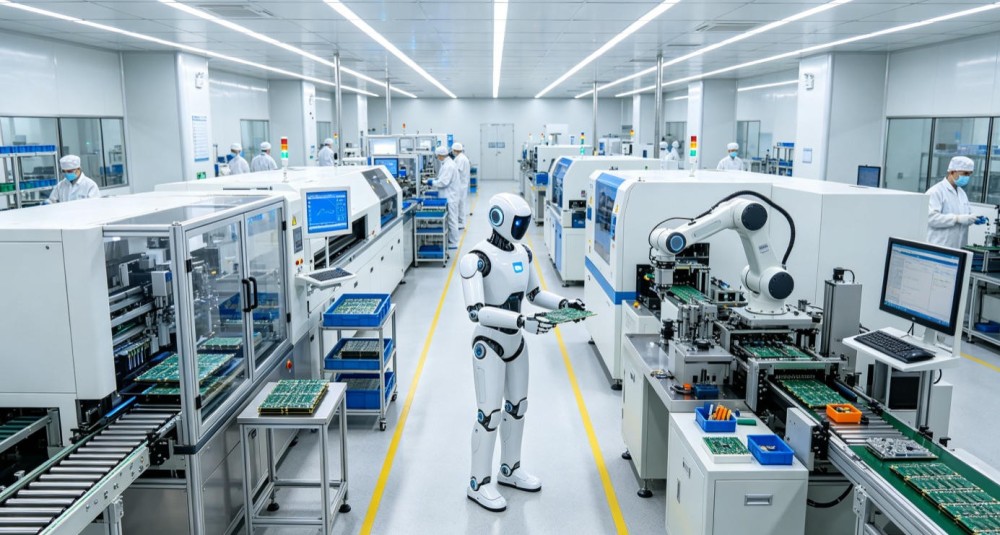
As The 3rd Hangzhou International Humanoid Robot and Robot Technology Exhibition 2027 (HRTE 2027), taking place May 27–29, 2027, at the Hangzhou Grand Convention and Exhibition Center in Zhejiang Province, approaches in Hangzhou, a field whose demands for accuracy, cleanliness, and stability border on the unforgiving is opening its gates to humanoid robots: 3C electronics precision manufacturing. On the lines that build smartphones, laptops, and wearables, components are measured in millimeters and sub-millimeters, and workshops treat dust and static electricity as mortal enemies. As general-purpose robot bodies acquire stable dual arms, dexterous fingers, and fine-grained vision, this highest and most demanding ground of automation is becoming the decisive test of the humanoid's advanced capabilities.
If transport and inspection are a humanoid robot's "introductory course," precision manufacturing is the "advanced exam"—a triple gate that screens entrants layer by layer.
The first gate is accuracy. According to publicly available information, positioning accuracy in 3C assembly is often measured at the 0.1-millimeter level; screwdriving, flex-cable insertion, and dispensing tolerate errors so small that a fraction of a millimeter can scrap an entire batch. This imposes demands on repeatability, arm rigidity, and end-effector force control that go far beyond what logistics scenarios ever ask. A human assembler compensates with feel and micro-corrections learned over years; a robot must rebuild that finesse from force sensors, impedance control, and thousands of simulated rehearsals before it ever touches a real jig.
The second gate is cleanliness and ESD protection. Electronics workshops are managed by cleanroom class, and a humanoid robot must not "shed"—hydraulic oil, particles, and electrostatic discharge can ruin batches of precision components. The body must therefore be designed for cleanroom compatibility and static protection from the start, rather than patched after arrival.
The third gate is changeover frequency. Consumer electronics iterate fast and launch often; lines are retooled "month by month, season by season." A dedicated machine must be recalibrated for every model change, while the humanoid's promise is precisely "one body, many tasks"—in theory absorbing small-batch, high-mix orders at far lower changeover cost.
There is also a quieter reason this arena matters. Precision lines run at high utilization with tight takt times, so any robot that enters must earn its place on availability and mean time between failures, not on novelty. The exam, in other words, is not only about what the robot can do once, but what it can repeat ten thousand times without drift, and that standard is what separates a laboratory curiosity from a line-qualified machine.
Placed on a 3C production line, a humanoid robot's plausible roles fall roughly into three categories.
The first is "assembly support and loading." Moving trays between stations, placing precision parts onto jigs, and lifting finished units off dedicated machines—these "semi-general" tasks need both the positional flexibility of a human and adequate hand precision, making them the natural interface between humanoids and existing special-purpose equipment. Some vendors are also exploring fine insertion and screwdriving performed directly by humanoids, though industry consensus treats those as mid-term goals rather than present-day reality.
The second is "quality check and re-judgment." Equipped with high-resolution vision and large models, a robot can run appearance checks at line nodes, identify screen blemishes, pre-screen solder defects, and—on finding a suspect—pick the unit, re-inspect it, quarantine it, and log the case. This role does not aim to replace AOI inspection machines; it fills the seam they cannot cover and that human eyes cannot sustain—corners and color shifts that need a different viewing angle to be seen at all. Because the robot can reposition its cameras freely, it effectively turns a fixed inspection station into a movable one, sampling problem-prone angles on demand instead of waiting for defects to surface downstream.
The third is "cleanroom logistics and guarding." Material transfer inside the cleanroom, night-shift standing watch, and environmental patrols—temperature and humidity, particle counts, equipment status—all need a general body that "walks, sees, and records." These tasks create no process value directly, yet they decide the continuity of the line and the stability of yield, which makes them the easiest foothold for robots to land first. They are also the tasks most often cited in recruitment difficulties—repetitive, unglamorous, and precisely the kind of work a general body can absorb without retooling a single station.
Why does this topic deserve focused discussion in Hangzhou? Because the Yangtze River Delta is one of the world's most important electronics manufacturing belts, and Zhejiang plays a distinctive role in it. Hangzhou's digital-economy and intelligent IoT base is strong, with mature ecosystems in smart hardware, vision algorithms, and industrial software; the automotive electronics, components, and module manufacturing of Ningbo, Jiaxing, and neighboring cities supplies an abundance of real scenarios that are precisely "high-precision, multi-variety, fast-iterating."
For humanoid robot companies, the advantage here is that "the supply chain is next door": upstream there are vendors of reducers, servos, sensors, and dexterous hands; downstream there are manufacturers willing to be first movers; and in between sit active system integrators and industrial-software firms. According to publicly available information, Zhejiang has in recent years promoted coordinated development of intelligent manufacturing and the robotics industry, providing policy and platform support for a three-way co-creation of "body makers plus scenario factories plus integrators"—including special funds, pilot-factory programs, and matchmaking events that shorten the distance between a prototype and a pilot line. This is exactly why HRTE 2027 places its stage in Hangzhou and focuses on the full humanoid robot industry chain—bringing the most demanding scenarios face to face with the most complete supply chain.
The outlook is promising, but precision manufacturing screens its robots most strictly, and three hurdles must be faced squarely.
The first is accuracy and repeatability. From "picking up a board" to "reliably completing a precision insertion" lies a gap of several orders of magnitude. Dynamic error during dual-arm coordination, thermal drift as the shop floor warms and cools, and end-effector vibration are all engineering details that must be solved one by one, verified not in demos but across full shifts.
The second is cleanliness and compliance. Entering a cleanroom is not a matter of "wiping things down": the particle emission rate of the robot's materials, the particulate output of its motors, and its ESD-protection design all require standard verification, plus compatibility with gowning, cleaning, and entry protocols. If this step fails, no amount of intelligence gets the robot through the door. This is also why several humanoid makers now ship cleanroom and ESD variants of their platforms as separate configurations—the factory floor is simply a different certification regime from the showroom.
The third is utilization and the ledger. 3C factories run dense schedules with tight takt, so a robot's availability and MTBF must reach line standards; and although precision manufacturing carries better margins than pure assembly, capital investment in the line is already enormous—whether one more humanoid is worth it must be calculated across yield improvement, changeover savings, and night-shift coverage together.
The pragmatic route is "edges first, core later." The easiest tasks to land first are inter-line logistics, quality re-judgment, and night-shift guarding—"general but off the critical takt"; once reliability accumulates, assembly itself can be probed. A 3C factory already runs many dedicated machines, arms, and AGVs; the humanoid's position is a "flexible node in fleet orchestration," not a teardown—sharing the same MES dispatch system with existing equipment and dividing tasks dynamically.
In business model, Robotics-as-a-Service (RaaS) and the "validation line" model are rising: factories need not make a heavy one-time investment, but pilot on a single validation line, paying against takt achievement and yield metrics, then replicate horizontally across lines once verified—so the risk of a wrong bet stays contained to one line rather than a whole plant. Combined with simulation training and digital twins, robots can first run stations and takt in a virtual line, then enter the real workshop—squeezing production impact to a minimum. And this kind of real conversation in the most demanding scenarios is precisely the agenda that HRTE 2027's body makers and manufacturers most look forward to.
Precision manufacturing is the high ground of automation and the true "measuring stick" of humanoid capability. It may not be the earliest scenario to scale, but it is likely the one that best separates technical leaders and accumulates the most valuable data. As accuracy, cleanliness, and economics pass their gates one by one, the humanoid will cease to be a "helper" beside the line and become a genuine "general worker" within the flexible manufacturing system.
HRTE 2027 will be an important window for observing this progress—by then, from body manufacturers to component suppliers, integrators, and manufacturers, more answers grounded in real production lines may well emerge.