
Zhejiang Robot Industry Association
Zhejiang University Robotics Institute
Golden Conference & Exhibition Group
Hangzhou Wisdom Source Exhibition Co., Ltd.
Hangzhou Sequoia Exhibition Co., Ltd.
Ningbo Magnetic Materials Association
As The 3rd Hangzhou International Humanoid Robot and Robot Technology Exhibition 2027 (HRTE 2027), taking place May 27–29, 2027, at the Hangzhou Grand Convention and Exhibition Center in Zhejiang Province, approaches in Hangzhou, a site that moves global cargo while wrestling with hazard and recruitment challenges is being reconsidered: the port terminal. As general-purpose robot bodies acquire stable walking, dual-arm manipulation, and all-weather perception, this forest of steel made up of containers, ship-to-shore cranes, and trucks is becoming another proving ground for humanoids to step out of indoor factories and into complex outdoor environments.
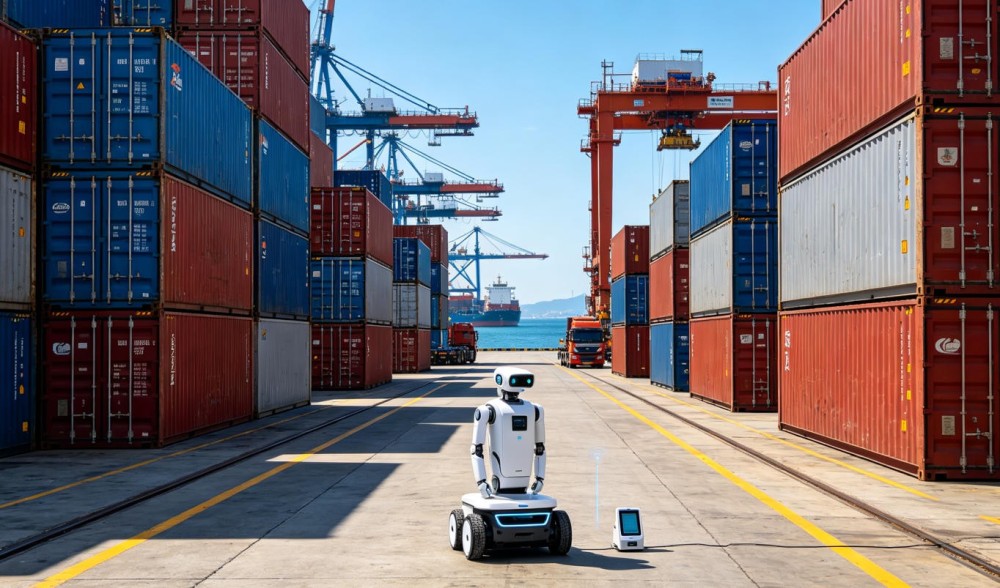
A port is a high-risk, high-intensity workplace. According to publicly available information, terminal operations such as loading, tallying, and inspection have long been constrained by harsh environments, heavy labor, and elevated safety risks. Sea spray carries salt fog, day-night temperature swings are sharp, surfaces stay wet and uneven, and heavy machinery moves constantly—a continuous test of both people and equipment.
The harder part is "non-standard work." Containers may be standardized units, but the tasks around them vary endlessly: checking container appearance, verifying seal integrity, patrolling the yard, confirming mooring and lashing states, inspecting hazardous-goods labels, and reporting equipment anomalies. Such work sends people back and forth across the site, often at night or around typhoon windows when conditions are worst. Conventional automation excels at repetitive motion along fixed routes; when a task needs on-the-spot judgment, cross-zone movement, or sharing space with people, it falters.
That is precisely the humanoid's entry point: it need not replace giants like quay cranes and gantry cranes, but can use a general body that "walks, sees, and manipulates" to take on the scattered, high-risk, human-coordinated tasks on the ground. There is also a labor dimension that is hard to overstate. Port work is physically punishing and unglamorous, and younger workers are increasingly reluctant to take it; in many mature ports the workforce is aging, which means the need for machines is structural rather than cyclical. Any solution must therefore fit alongside existing crews and equipment, not assume a greenfield site where every process can be redesigned from scratch.
Placed on a terminal, a humanoid robot's roles roughly fall into three categories.
The first is "patrolling"—routine inspection of equipment and grounds. Following autonomous routes along the yard and quay, it checks whether container stacks are stable, whether boxes show damage or corrosion, whether fire and lighting facilities are intact, and whether water or obstacles block the way. With infrared and acoustic sensors, it can flag abnormal equipment heating or unusual noise, streaming live footage and data back to the dispatch center. Because the robot patrols on a steady rhythm rather than a tired human schedule, coverage becomes more consistent across every shift. It can also return to a suspected trouble spot on demand, circling for a second look or a closer thermal reading—something a fixed camera mounted in one position can never do.
The second is "tally assistance"—label recognition and information verification. Through machine vision, the robot reads container numbers, seal status, and hazardous-goods markings, supporting tallying and document checks and reducing the need for staff to walk the box rows repeatedly with clipboards. The aim is not full autonomy but a shift from "people hunting for goods and matching documents" to "robots pre-screening, people double-checking"—raising throughput while cutting error rates, especially under the glare and fatigue of a night shift. The data captured at the same time also matters: a photo log tied to each container builds a traceable record that helps when a dispute over condition or seal integrity arises later.
The third is "response"—lightweight operations and emergency linkage. Within preset authority, the robot can operate valves, press controls, clear small obstructions, and lay temporary barriers; on detecting a leak, fire, or personnel anomaly, it immediately streams the scene and triggers coordinated response. Moving from "detecting a problem" to "stabilizing it first" is the distinctive value a humanoid brings beyond fixed cameras and wheeled patrol cars.
Why does this topic deserve focused discussion in Hangzhou? Because Zhejiang is home to Ningbo-Zhushan Port, long ranked among the world's leaders in cargo throughput, together with a vibrant port economy and coastal industrial belt. According to publicly available information, the port handles container, bulk, and liquid-chemical terminals of striking variety, offering a scene richness and operating complexity that amount to an "extreme exam" for outdoor humanoid work.
For robot companies, the attraction is "scenario density": automated terminals coexist with conventional bulk and general-cargo berths, so the site can validate the hardest tasks while also offering medium-difficulty footholds that could be replicated at scale. Add the Yangtze River Delta's industrial accumulation in robot bodies, sensors, machine vision, communication modules, and intelligent equipment, and a collaborative loop of "ports propose needs, local supply chains respond quickly" begins to form. This is exactly why HRTE 2027 places its stage in Hangzhou and focuses on the full humanoid robot industry chain—bringing the harshest working conditions face to face with the most complete supply chain.
The outlook is attractive, but the port sets three hard hurdles that must be faced directly.
The first is environmental adaptation. Salt-fog corrosion, strong winds, rain, and alternating heat and cold impose strict demands on a robot's ingress protection, sealing, and material durability. A body that walks steadily in a lab may not survive months of continuous duty on a seaside quay, where salt creep into joints and connectors is a slow but relentless failure mode. Wind also changes the balance equation for a biped, so gait control that ignores gusts will simply fall over on an exposed deck.
The second is complex outdoor navigation. Ports lack the tidy structure of an indoor factory: stacked containers form canyons, GPS signals can be blocked between box rows, floor markings fade, and trucks, forklifts, and workers share the space. To localize reliably and avoid obstacles in such dynamic, semi-structured surroundings places extreme demands on multi-sensor fusion and autonomous decision-making. The robot must know not only where the lane is, but which way a truck is turning and when a worker has stepped around a stack.
The third is safety and accountability. A port is critical transport infrastructure, where a single misjudgment can affect operational safety and cargo flow. How a robot's response authority is defined, how it coordinates with human crews, and who bears responsibility if something goes wrong—until these institutional questions are settled, large-scale duty remains out of reach.
The pragmatic pace is to start with "dangerous, repetitive, auxiliary" posts rather than chase a full unmanned terminal overnight. The easiest footholds are yard patrol, night watch, and label-assistance checks—tasks with high risk and clear boundaries; once reliability is proven, the robot can edge toward more complex operations. Early pilots are also likely to favor terminals with digital infrastructure already in place, where data interfaces and yard maps exist, over older berths that would require heavy retrofitting before a robot could even be oriented.
In business model, Robotics-as-a-Service (RaaS) fits the port's tidal rhythm well: charging by shift or by patrol distance, the port avoids a heavy one-time purchase while the supplier handles upkeep and upgrades. More important is cooperation, not substitution. Driverless trucks, automated quay cranes, and gantry cranes remain the mainstay of terminal work; humanoids fill the "final lap" of field tasks those systems cannot reach, while workers move from hazardous foot patrols to remote monitoring and exception handling.
Combined with simulation training and digital twins, robots can rehearse patrol routes and emergency procedures in a virtual terminal before entering a real yard—compressing trial-and-error costs. A digital twin that mirrors the liveyard layout also lets operators adjust patrol priorities as container blocks shift, without sending someone out to re-teach the route. This kind of candid dialogue under real, harsh conditions is precisely the agenda that HRTE 2027's body makers and port operators are most eager to pursue face to face.
Ports are the gateways of global trade and among automation's toughest outdoor scenarios. Humanoids entering terminals does not mean unmanned ports overnight; it means a general body taking over the most dangerous and tedious field tasks, freeing people from high-risk settings. Because a port runs around the clock, the value of a tireless patroller compounds across every night shift and storm watch, where human coverage is thinnest and the cost of a missed fault is highest. As environmental robustness, outdoor navigation, and accountability frameworks mature, this track could become another frontier for humanoids to scale beyond indoor floors and into the open air.
HRTE 2027 will be an important window for observing this progress—by then, from body manufacturers to port integrators and operators, more answers grounded in real working conditions may well emerge.