


Zhejiang Robot Industry Association
Zhejiang University Robotics Institute
Golden Conference & Exhibition Group
Shanghai Top Sequoia Exhibition Co., Ltd.
Shanghai Berrick Exhibition Co., Ltd.
Shanghai, July 20, 2026 — The four-day World Artificial Intelligence Conference 2026 (WAIC 2026) concluded successfully today in Shanghai. Under the theme "Intelligent Partners, Co-creating the Future", embodied intelligence and humanoid robots headlined the exhibition for the first time, featuring over 200 companies and 300+ physical robots. The event showcased a milestone transition of China's humanoid robot industry from technology validation to large-scale mass production.
Latest data from the Ministry of Industry and Information Technology (MIIT) confirms that China's humanoid robot sector is in a high-growth trajectory. The country now hosts over 140 full-scale humanoid robot manufacturers with more than 400 product models. Annual production is projected to exceed 100,000 units in 2026, accounting for 84.7% of global output — solidifying China's position as the world's largest humanoid robot market for consecutive years.
Across the broader robotics landscape, China's robot market reached USD 15.5 billion in 2026, growing 16.7% year-on-year and maintaining its title as the world's largest industrial robot market for 13 consecutive years. The embodied intelligence segment demonstrates even stronger momentum: the domestic market size exceeds RMB 22 billion in 2026, with industry forecasts projecting a breakthrough to RMB 200 billion by 2030 — representing a CAGR of over 70% and making it one of the most promising growth verticals in artificial intelligence.
China's global leadership continues to widen. According to the Global AI Innovation Index Report 2026, China accounted for 88.7% of global humanoid robot shipments in 2025. Chinese companies hold over 80% of global commercial service robot shipments and rank first worldwide in humanoid robot patent applications.
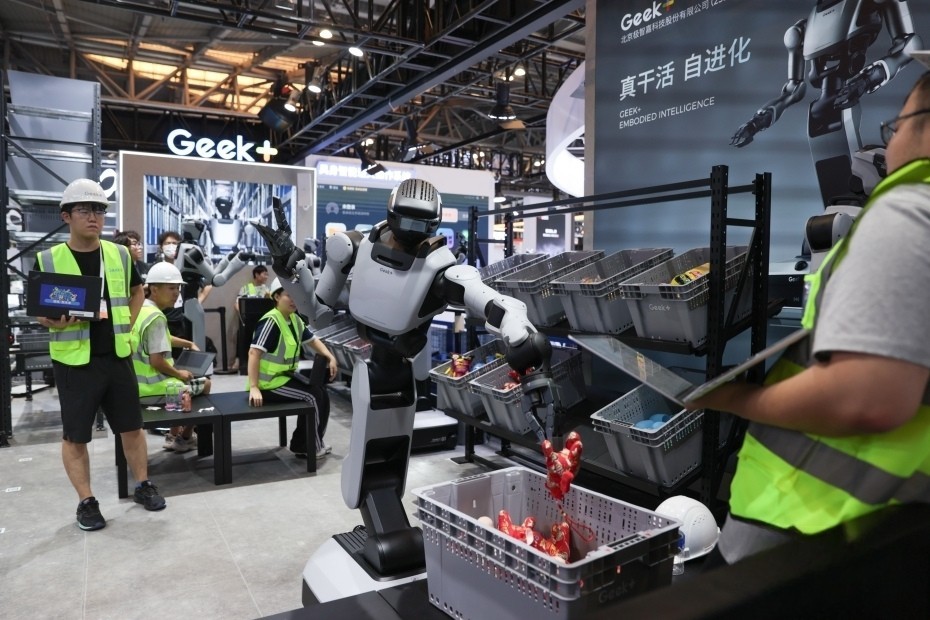
"Mass production" emerged as the industry consensus at WAIC 2026, with 2026 widely recognized as the "Year One of Humanoid Robot Mass Production." Leading manufacturers reported impressive production milestones:
Zhiyuan Robotics: The company rolled out its 15,000th unit just before the conference, reaching the 10,000-unit milestone in under three months. Its flexible production capacity now exceeds 100,000 units annually. Its flagship model, the Expedition A3 Ultra, was named a "Treasure of the Exhibition" — the world's first full-size humanoid robot ready for commercial mass deployment. Equipped with a 700-TOPS embodied processor, it supports 24/7 continuous commercial operation.
Zhishen Technology: Cumulative production exceeded 15,000 units as of June 2026, with monthly output surpassing 5,000 units in June alone, demonstrating a steep commercialization curve.
Unitree Robotics: Annual production capacity target set at 190,000 units, with quadruped and humanoid product lines scaling in parallel.
UBTech: 2026 shipment target raised to 5,000 units, accelerating B-side commercial deployment.
On the supply chain front, domestic substitution is progressing faster than expected. The overall localization rate of core components across all humanoid robot categories has surpassed 75%, with the 14th Five-Year Plan targeting ≥80% localization for core components by 2026. Mature domestic supply chains for reducers, servo motors, and controllers have laid a solid foundation for cost reduction at scale.
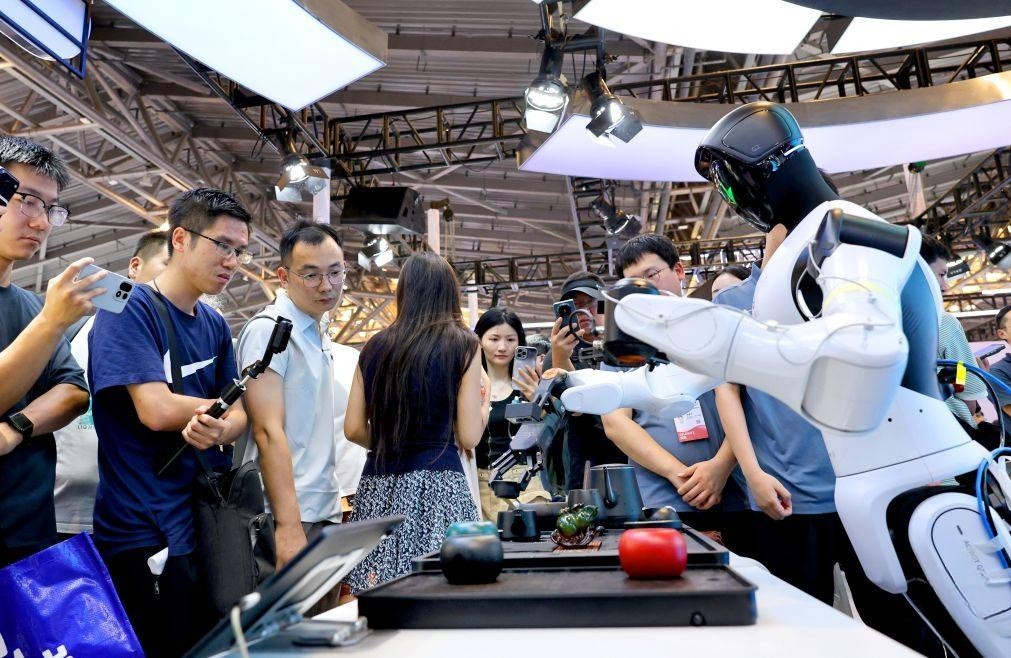
Unlike previous editions that showcased acrobatic feats such as backflips and dance routines, WAIC 2026 marked a decisive shift toward practical application scenarios. "Getting work done" has replaced "putting on a show" as the new industry benchmark.
Industrial deployment leads the way: Leju Robotics replicated a factory assembly line at the exhibition, demonstrating 8 hours of continuous depalletizing and material handling operations. The company has secured bulk orders from leading manufacturers including FAW and Changhong. Galbot S1 has been operating 24/7 on CATL production lines for over three months, with deep partnerships established with SAIC, BAIC, Bosch, and Hyundai. DeepRobotics' DR02 humanoid robot has completed field testing for substation inspection tasks and officially launched commercial deployment in 2026.
Commercial services are expanding simultaneously. Nearly 60 humanoid robots performed actual on-site duties including guidance, explanation, and visitor assistance throughout the conference — marking the first large-scale deployment of humanoid robots at a major Chinese exhibition. The Zhiyuan Expedition A3 Ultra operated as a "24-hour premium receptionist," autonomously patrolling the venue with 360° vision and LiDAR navigation through crowded environments.
Research and specialized scenarios also saw breakthroughs. The "Embodied Tiangong" series from Beijing Humanoid Robot Innovation Center and PNDbotics' full-size humanoid demonstrated stair climbing and rough terrain navigation capabilities, reserving technical solutions for high-value scenarios such as industrial inspection and emergency response.
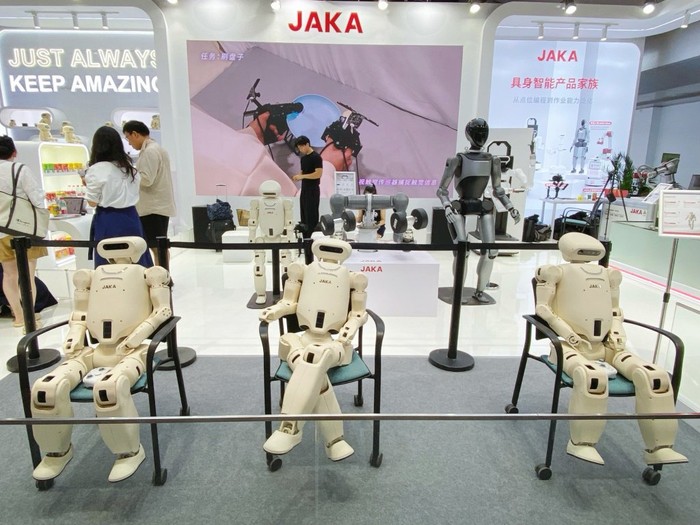
Top-level policy support continues to strengthen. In February 2026, MIIT released the Humanoid Robot and Embodied Intelligence Standard System (2026 Edition), providing a regulatory framework for the entire industry chain. The 14th Five-Year Plan has incorporated embodied intelligence into the national strategic emerging industries layout. MIIT's newly launched "Model-Data Resonance" initiative, piloted in Shanghai and the Yangtze River Delta, targets deployment of 100,000 industrial humanoid robots by the end of the 14th Five-Year Plan period.
China's manufacturing ecosystem is the fundamental driver behind its robotics ascent. The Yangtze River Delta and Pearl River Delta host complete robotics industry clusters. End-to-end domestic supply capabilities — from chips, reducers, and sensors to body manufacturing and system integration — significantly shorten product iteration cycles and reduce manufacturing costs. Zhiyuan's A-chain supply ecosystem now includes nearly 40 core industry partners, while the Digua robot platform has coordinated adaptation with over 100 supply chain participants, reflecting a maturing collaborative industrial ecosystem.
With maturing technology and cost advantages, Chinese humanoid robots are gaining global competitiveness. The primary driver for overseas importers is shifting from "low prices" to a comprehensive value proposition combining cost-effectiveness, rapid delivery, and customization capabilities.
Southeast Asia's manufacturing relocation wave has created strong demand for factory automation and affordable humanoid robot solutions. European and North American markets focus on commercial services, research, and education, with growing acceptance of China's mature quadruped and wheeled service robot products. Segments like robotic lawn mowers and commercial cleaning robots have already achieved large-scale export success, serving as the vanguard of China's robot overseas expansion.
Industry analysts identify 2026-2030 as the critical window for shaping the global humanoid robot industry landscape. With its complete supply chain, vast application market, and policy tailwinds, China is positioned to sustain its leadership in global humanoid robot industrialization — providing essential technology and product support for global manufacturing upgrading and intelligent transformation.
Sources: Ministry of Industry and Information Technology, Global AI Innovation Index Report 2026, WAIC 2026 official releases, company disclosures