
Zhejiang Robot Industry Association
Zhejiang University Robotics Institute
Golden Conference & Exhibition Group
Hangzhou Wisdom Source Exhibition Co., Ltd.
Hangzhou Sequoia Exhibition Co., Ltd.
Ningbo Magnetic Materials Association
A Visit to a Humanoid Robot Factory with an Annual Output of 10,000 Units
“The biggest hurdle for mass production lies in stable, consistent manufacturing” By Reporter Jiang Xiaodan
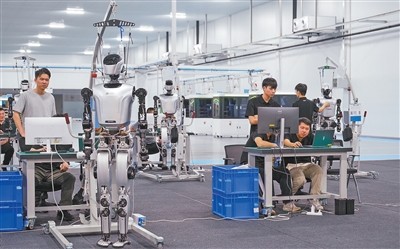
Step into the factory of Orient Yuanqi Intelligent Robotics (Guangdong) Co., Ltd. in Nanhai District, Foshan, Guangdong Province. The workshop is bright and tidy, with intelligent equipment running in orderly fashion. This smart manufacturing plant, jointly built by Lepu Intelligence (Shenzhen) Co., Ltd. and Guangdong Dongfang Precision Science & Technology Co., Ltd., serves as a large-scale production base for humanoid robots with an annual capacity of 10,000 units.
What are the core challenges of mass-producing humanoid robots? Li Deping, Director of the Artificial Intelligence Teaching and Research Office at Jinan University, explains that humanoid robots feature interconnected multi-joint structures. Tiny discrepancies such as uneven screw tightness get amplified, leading to obvious deviations in walking and gripping motions. Additionally, the industry lacks unified component standards, with incomplete supporting supply of sensors and bionic parts. Each robot model requires separate calibration of motion and force control parameters, making it extremely difficult to mass-produce products with uniform performance.
This mass-production facility leverages a fully integrated intelligent production line design to tackle these manufacturing pain points head-on.
The intelligent material management zone boasts a highly automated logistics system that delivers remarkable efficiency. Staff only need to complete identity verification to unlock corresponding material cabinets, where required components are neatly arranged for precise picking. Once collection finishes, the system automatically weighs, counts and cross-checks inventory. Even the removal of a single screw or washer is captured accurately with real-time data updates.
After materials are sorted for outbound delivery, Automated Guided Vehicles (AGVs) act as intelligent transporters to deliver components to each workstation with pinpoint accuracy. Heavy-duty AGVs handle long-distance cross-zone transport of bulky parts including robot torsos and frames; light-duty AGVs shuttle small components such as screws, cables and sensors within assembly zones; lift-top AGVs directly deliver material pallets to designated production line heights for seamless docking with workflows. All AGVs follow pre-planned routes, autonomously avoiding collisions and moving in sequence without human escorts, enabling smooth, efficient material circulation.
Further ahead lies the core assembly zone for humanoid robots. Unlike traditional assembly lines, this area adopts modular, synchronous and flexible production workflows. Key components including arm/leg assemblies, torsos and heads are assembled simultaneously at separate stations, with staff working closely alongside automated equipment. Dozens of procedures from structural fitting and wiring to sensor calibration proceed methodically across the steady, uninterrupted production line.
The line’s exceptional versatility also leaves a deep impression: multiple humanoid robot models with different configurations are manufactured concurrently in the central zone of the workshop. “We adopted a flexible design from the project’s inception. We only need to switch production instructions on the system to rapidly adjust robot models and specifications, completing the transition within minutes,” said Cao Yu, Vice President of Lepu Intelligence. On the hardware side, only end effectors and specific joint modules require replacement, with no physical reconstruction of the production line needed. On the software side, the system automatically loads matching assembly parameters and adaptation programs for zero-disruption workflow shifts.
Quality control commences the moment components enter the factory. Most inspection procedures are universal for wheeled mobile robots and humanoid robots alike, with testing priorities adjusted based on product positioning. Cao Yu provided an example: wheeled robots undergo rigorous testing of wheeled chassis stability for smooth driving and steering performance, while humanoid robots are evaluated primarily on gait balance and dual-arm coordination, with trials including stair climbing and stable locomotion over complex terrain.
At the end of the production line, every robot undergoes a pre-delivery comprehensive inspection. Technicians push the robot’s body forcefully, which must maintain a stable upright stance. The robot executes 180-degree waist rotations and flexible joint flexion/extension with fluid, natural movements. High-precision monitoring equipment verifies each walking, turning and positioning function item by item. Staff also simulate real-world operational scenarios to conduct multi-dimensional testing, ensuring reliable performance in practical environments. Only robots passing all assessment criteria qualify for delivery.
“Mass production is not defined by volume or speed; its greatest challenge is consistent, stable manufacturing,” noted the technical lead of Orient Yuanqi. This stands as one of the critical tests for large-scale production. “We invest heavily in pre-market testing to prevent defective products from entering commercial circulation.”
Cao Yu stated that humanoid robots have seen preliminary deployment across industrial manufacturing, commercial services, education and research scenarios. As technology matures, application scenarios expand and market demand surges, humanoid robots will take on an increasingly diverse array of tasks and assume more vital roles—all built upon consistent, reliable mass production capacity.
Liu Ning, Dean of the Institute of Robotics and Intelligent Technology at Jinan University, believes the humanoid robot industry remains in its early developmental stage. Bottlenecks in sensor and bionic actuator technology, paired with a scarcity of mature commercial application scenarios, have restrained large bulk order releases. In the long run, however, iterative hardware upgrades and continuous expansion of real-world deployment will drive growing market demand, making large-scale mass production an inevitable industry trend.
Uncovering Electrical Steel Specially Developed for Humanoid Robots
Robust Power Generated by a 0.2-Millimeter Sheet By Reporter Wang Yunshan
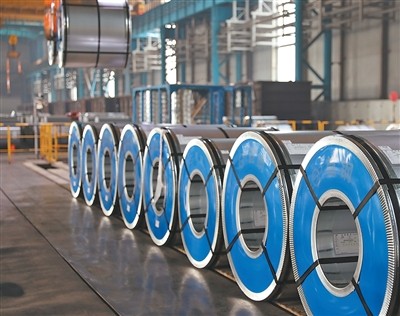
Electrical steel, the core material enabling efficient conversion between electrical and magnetic energy, is hailed as the crown jewel of the steel industry. It underpins long driving range and high power output in new energy vehicles; supports stable current transmission and efficient energy conversion in large transformers; and delivers lower power consumption and smoother operation in high-end home appliances. From household appliances and new energy vehicles to ultra-high voltage power grids, ultra-thin electrical steel sheets form the power backbone of modern industries.
At the Early Supplier Involvement (ESI) Laboratory of Shougang Zhixin in Qian’an, Hebei Province, research engineer Zhang Bao bends over to examine a sample: ultra-thin 0.2mm electrical steel custom-built for humanoid robots.
Zhang Bao explained that as humanoid robot technology advances rapidly, this tailor-made ultra-thin steel sheet—no thicker than a human hair—enables compact motors to generate powerful torque, perfectly meeting the stringent lightweight, high torque density and high power density requirements of humanoid robotics. “A single robot carries 40 to 50 or more motors, each dependent on electrical steel to support fluid movement, precise manipulation and stable force output.”
Compared with motors for new energy vehicles, humanoid robot motors feature smaller dimensions and higher integration, demanding far more extreme material performance. High torque equates to greater mechanical power, allowing robots to walk, lift objects and execute complex motions; low core loss translates to reduced heat generation and energy consumption, eliminating the need for complex cooling systems during operation. “These two performance metrics stand in inherent tradeoff—optimizing one often compromises the other,” Zhang Bao noted.
How to resolve this conflict within a minuscule material footprint? Shougang’s R&D team completed over 600 formula trials and more than ten industrial validation rounds across an entire year of laboratory work, finally striking an optimal balance between magnetic induction, core loss and torque output. Compared with conventional commercial alternatives, this custom 0.2mm steel sheet cuts core loss by 20% to 30%, enabling robot motors that are smaller, more powerful and more energy-efficient.
While the humanoid robot market remains nascent with widespread large-scale commercialization yet to arrive, Shougang has proactively laid industrial groundwork to support the sector’s future explosive growth. “Back in 2015, when electrical steel for home appliances dominated market demand, we anticipated the upcoming boom in new energy vehicles and pivoted R&D toward electrical steel for EV traction motors,” recounted An Dongyang, Chief Technical Expert at Shougang Zhixin. Today, Shougang’s electrical steel products supply all ten top global new energy vehicle manufacturers, capturing one-third of China’s domestic market share.
“Industry estimates indicate every 10,000 humanoid robots consume approximately 100 tons of electrical steel. As humanoid robots enter households nationwide, this ultra-thin steel material will unlock a new market worth hundreds of billions of yuan,” An Dongyang projected.
On a broader industrial perspective, Shougang’s deep specialization in this niche segment exemplifies the overall upward breakthrough of China’s electrical steel industry.
On the supply side, China fully mastered advanced electrical steel production technologies and processes during the 14th Five-Year Plan period. High-end grades including electrical steel for new energy vehicles and ultra-high voltage power transmission transformers now match or surpass global industry benchmarks. Data from the China Iron and Steel Association shows China’s total electrical steel output reached approximately 19.633 million tons in 2025, a year-on-year increase of 9.6%, accounting for 2.04% of national crude steel production.
On the demand side, Chen Zhu, Expert Advisor to the Science, Technology and Environmental Protection Department of the China Iron and Steel Association, analyzed three major growth drivers for electrical steel demand during the upcoming 15th Five-Year Plan period:
Sustained expansion of the new energy vehicle market. Rising market penetration of China’s EV sector will create one of the largest incremental demand pools for non-oriented electrical steel.
Investment-driven growth in the power sector. China’s fixed-asset investment in power grids will exceed 5 trillion yuan throughout the 15th Five-Year Plan, lifting demand for high-end oriented electrical steel used in transformers.
Rapid rise of emerging sectors. Low-altitude economy applications including drone servo motors and flying car electric drive systems will boost adoption of ultra-high performance electrical steel. Miniature special motors embedded within robot joint actuators, robotic vacuum cleaners and other intelligent terminals will generate steady long-term demand for electrical steel materials.
Tailoring New Outer Skins for Humanoid Robots
Beyond Protective Casings: The Evolution Toward Electronic Skin By Reporter Huang Xiaohui
Click-clack sounds fill a garment workshop in Jiangqiao Town, Jiading District, Shanghai. Yet the fabrics stitched by Lei Wen differ drastically from heavy industrial workwear: sleek silver outer coverings crafted for humanoid robots. This flexible textile casing withstands 180-degree mechanical arm torsion and cushions expensive joint components like an airbag if the robot accidentally topples over. “A single damaged robotic arm incurs substantial replacement costs,” Lei Wen remarks as he inspects seamless wrapping details around robot joints.
Lei Wen founded Shanghai Zixi Garment Co., Ltd. in 2004 after relocating to Shanghai from Xiantao, Hubei Province, initially manufacturing traditional industrial uniforms. Over several years, he established a foothold in Jiangqiao Town, a cluster for advanced textile materials and apparel manufacturers. Amid the rise of smart manufacturing, Lei Wen identified a critical market pain point: imported protective suits for industrial robots cost tens of thousands of yuan each, with lead times stretching several months. His team overcame high-temperature fabric resistance challenges to independently develop welding and spraying protective suits priced at half the cost of imported equivalents, securing orders from numerous manufacturers.
In 2023, an engineer posed a unique design challenge: creating highly elastic robotic enclosures that eliminate the bulk of conventional industrial protective gear. The textiles needed flame retardancy, breathability, seamless joint flexion without jamming, secure fit during movement, and washable construction. To tackle this task, Lei Wen’s workshop introduced intelligent nesting cutting equipment and 3D laser scanners. Digital modeling simulates full-axis robot motion trajectories to optimize pattern designs.
“Examine the shoulder seams,” Lei Wen points to seamless joints on prototype suits. “We integrated anti-slip silicone strips. After dozens of emergency stop cycles in field testing, the textile shifts less than several millimeters out of position.” Years of cumulative technical expertise positioned the company to capitalize on the robotics industry’s rapid expansion. In 2025, the firm shipped 1,000 sets of humanoid robot outer skins, emerging as a certified supplier for enterprises including Unitree Robotics and AgiBot. “Previously, we visited client facilities to take custom measurements for each robot model. Now manufacturers deliver their robots to our workshop to co-develop new textile designs.” The company currently collaborates with universities and fabric suppliers to develop textile surfaces embedded with integrated temperature and pressure sensor arrays, aiming to transform basic robot outer casings into functional electronic skin capable of collision detection and surface thermal sensing.
While Lei Wen develops flexible outer coverings for robot torsos, in a research lab in Songjiang District, knitwear designer Ding Hanqing knits fine textile sleeves for robotic fingertips. Ding Hanqing’s team specializes in knitwear R&D, until late last year when an embodied intelligence firm commissioned custom textile outer casings for its humanoid robot platforms. Ding Hanqing recalled the client’s strict specifications: the fabric must conform seamlessly to every curved industrial surface like human skin, resist wrinkling under torsion, feature pre-cut ports for all sensor interfaces, and function as a wearable intelligent device.
The team repurposed its proprietary 3D knit pattern calculation technology, originally developed for high-fashion apparel, converting each mechanical curved surface into tailored knit panels. High-elastic yarns precisely control fabric thickness and rebound performance, creating a skin-like conformal covering that is fully removable and washable.
Today, the volume of orders for robotic “skin” textiles matches the team’s traditional knitwear development business, with clients spanning embodied intelligence firms, medical rehabilitation equipment manufacturers and dexterous robotic hand developers. The R&D team is now testing conductive yarns woven into knit structures, paired with algorithmic systems to unlock pressure perception and tactile feedback capabilities. “We remain in the testing phase, yet our development roadmap is clear: next-generation robots will possess the ability to physically sense external contact,” Ding Hanqing explained.
People’s Daily, Page 11, July 28, 2026